// NATURE NEWS — SPAZIO & SCIENZA
Narrow carbon pentaheptite nanoribbon as a covalent metal
Nature
volume 658, pages 1176–1182 (2026) Cite this article
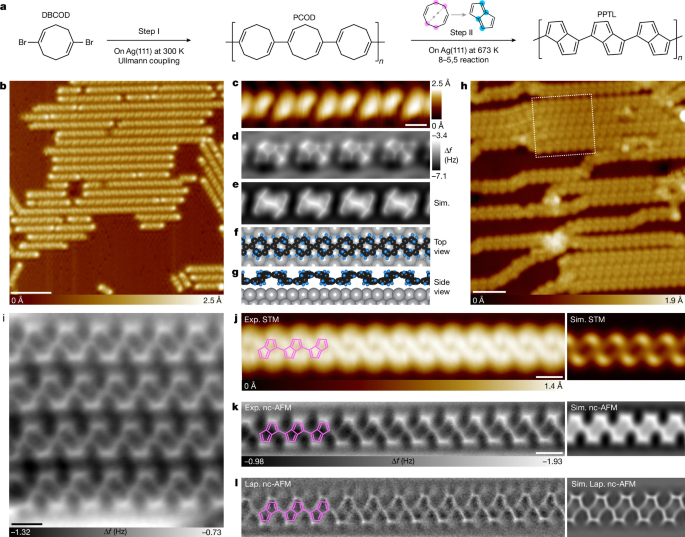
Metallic carbon-based nanoribbons are sought after1,2 as atomically defined one-dimensional conductors with potential relevance to future carbon-based electrodes and interconnects3, ideally with quantum-limited conductance comparable to metallic carbon nanotubes4. Metallic graphene nanoribbons have been realized by band engineering, notably through zero-mode superlattices1. However, atomically precise metallic nanoribbons of fully non-benzenoid carbon allotropes, such as the theorized metallic carbon pentaheptites5,6, remain unexplored. The realization of these nanoribbons could enable bottom-up fabrication of all-carbon electronics7,8 compatible with semiconducting graphene nanoribbons9,10,11,12,13 and nanographenes14,15, along with their fascinating properties16,17,18,19,20. Here we report a hierarchical approach for the on-surface synthesis of planar carbon pentaheptite nanoribbons (CPHNs) by laterally fusing well-aligned polypentalene chains transformed from pre-synthesized polycyclooctadiene chains. Two distinct types of narrow pentaheptite nanoribbon share a similar basal structure consisting of a central heptagon chain flanked by either identically (CPHN 1) or differently (CPHN 2) oriented polypentalene chains on opposite lateral edges. CPHN 1 is an intrinsic metal, whereas CPHN 2 is a narrow-bandgap semiconductor. The CPHN 1 ribbon exhibits near-ballistic conductance approaching one conductance quantum, comparable to metallic carbon nanotubes4. This highlights CPHN 1 as a promising planar carbon metal and suggests a possible route towards carbon quantum wires, although further synthetic optimization will be required for device integration.
This is a preview of subscription content, access via your institution
Access Nature and 54 other Nature Portfolio journals
Get Nature+, our best-value online-access subscription
Prices may be subject to local taxes which are calculated during checkout
The code used for the tight-binding calculations and LDOS analysis is available from the corresponding authors upon request.
Raw experimental data, including STM and AFM images and spectra, and numerical data from theoretical calculations underlying all figures in the main text, Extended Data and Supplementary Information are publicly available via Zenodo at https://doi.org/10.5281/zenodo.22228127 (ref. 42). Computational input and output files are available from the corresponding authors upon request.
Rizzo, D. J. et al. Inducing metallicity in graphene nanoribbons via zero-mode superlattices. Science 369, 1597–1603 (2020).
Article
ADS
CAS
PubMed
Google Scholar