// NATURE NEWS — SPAZIO & SCIENZA
SWI/SNF complexes shape 3D chromatin architecture through CTCF and cohesin
Nature
(2026) Cite this article
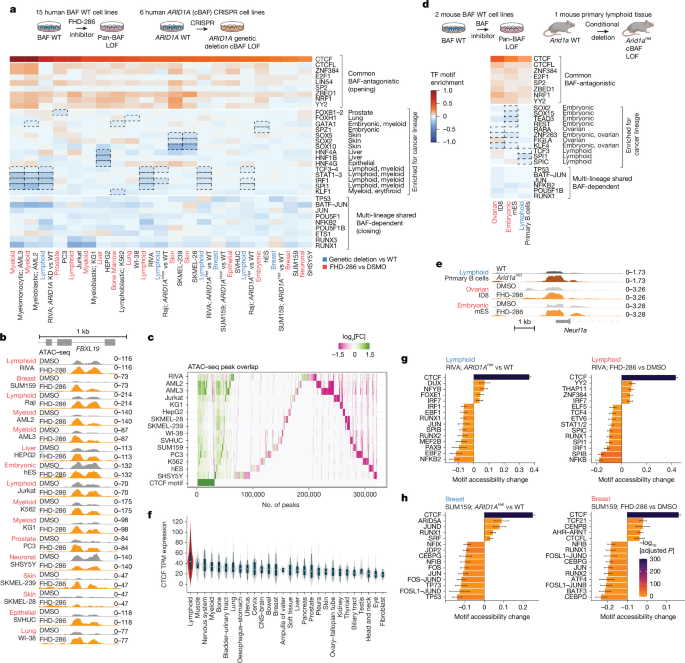
The BAF (also known as mammalian SWI/SNF) chromatin remodelling complexes are essential regulators of nucleosome positioning and transcription factor binding1,2. Loss-of-function (LOF) mutations in genes encoding components of the BAF complexes are among the most frequent across cancer types3. However, a unifying mechanism that explains their widespread disruption remains unclear. Here we disrupted BAF function through pharmacological inhibition and ARID1A deletion across various mammalian cell types and tissues and observed a conserved chromatin response: increased accessibility at CTCF-binding sites. ARID1A LOF alone was sufficient to drive these changes, which demonstrates that canonical BAF (cBAF) disruption is the key driver of CTCF gain. Genomic profiling showed increased CTCF and SMC3 occupancy, which reveals an antagonistic relationship between cBAF and CTCF–cohesin complexes. Furthermore, cBAF loss restructured 3D genome organization, which led to a strengthening of topologically associating domain boundaries and subdivision of large domains into smaller insulated structures. Long-range enhancer–promoter loops were replaced by shorter, promoter-proximal loops anchored at CTCF-enriched sites. To determine how CTCF function is enabled following cBAF loss, we profiled CTCF-interacting cofactors and found that CTCF binds directly to fully assembled PBAF. After cBAF depletion, PBAF was recruited to sites of increased CTCF occupancy, which demonstrates that there is an antagonistic switch between SWI/SNF subcomplexes. In vivo, conditional Arid1a deletion in primary mouse cells resulted in the expansion of a highly proliferative population marked by elevated accessibility at CTCF sites. This phenotype was fully reversed by either Ctcf or Pbrm1 deletion, which establishes that cBAF and the activity of CTCF and PBAF have contrasting roles.
The BAF complex remodels chromatin by repositioning or evicting nucleosomes, which enables transcription, transcription factor (TF) binding and DNA replication1,2,3,4. Genes encoding BAF subunits are among the most frequently mutated in cancer, with LOF alterations present in around 20% of patients across nearly every tumour type3,5,6. Despite the widespread involvement of BAF complexes across cancers, a unifying mechanism of how BAF LOF contributes to transformation across diverse tissue types has not been clearly established.
In mammals, BAF complexes are highly diverse and feature numerous non-catalytic auxiliary subunits. So far, three main BAF complexes have been characterized in mammalian cells: the cBAF complex, the polybromo-BAF complex (PBAF) and the non-canonical BAF complex (ncBAF). Each of these has distinct and overlapping biochemical properties, chromatin targets and roles in disease7,8,9,10,11. The mechanisms by which mutations in BAF complexes promote oncogenesis include impaired chromatin accessibility at key enhancers and promoters and altered dynamics of interactions between transcriptional co-activators and TFs3,4,12,13. However, it remains unclear whether BAF LOF affects chromatin structure beyond nucleosome positioning and whether different BAF subunits have distinct or shared functions across tissues.
Beyond nucleosome positioning, epigenetic and transcriptional programming is controlled through higher-order architectural remodelling of the genome. However, it is unclear whether BAF complexes regulate 3D genome organization, despite growing evidence that other chromatin remodellers have a role in higher-order chromatin folding14,15,16. Although architectural proteins such as CTCF and cohesin have been extensively studied17,18,19,20, how BAF influences higher-order chromatin structures and regulates chromatin topology has not been fully explored. BAF complexes have a crucial role in nucleosome remodelling, and emerging links have been identified between other chromatin remodellers and higher-order genome o