// SPACE.COM — SPAZIO & SCIENZA
'We got it done!' Spacewalking astronauts finish installing next-gen ISS solar arrays
When you purchase through links on our site, we may earn an affiliate commission. Here’s how it works.
Just as NASA is preparing to demonstrate "Max Power" on the ground, two astronauts on a spacewalk have provided the International Space Station (ISS) with the same.
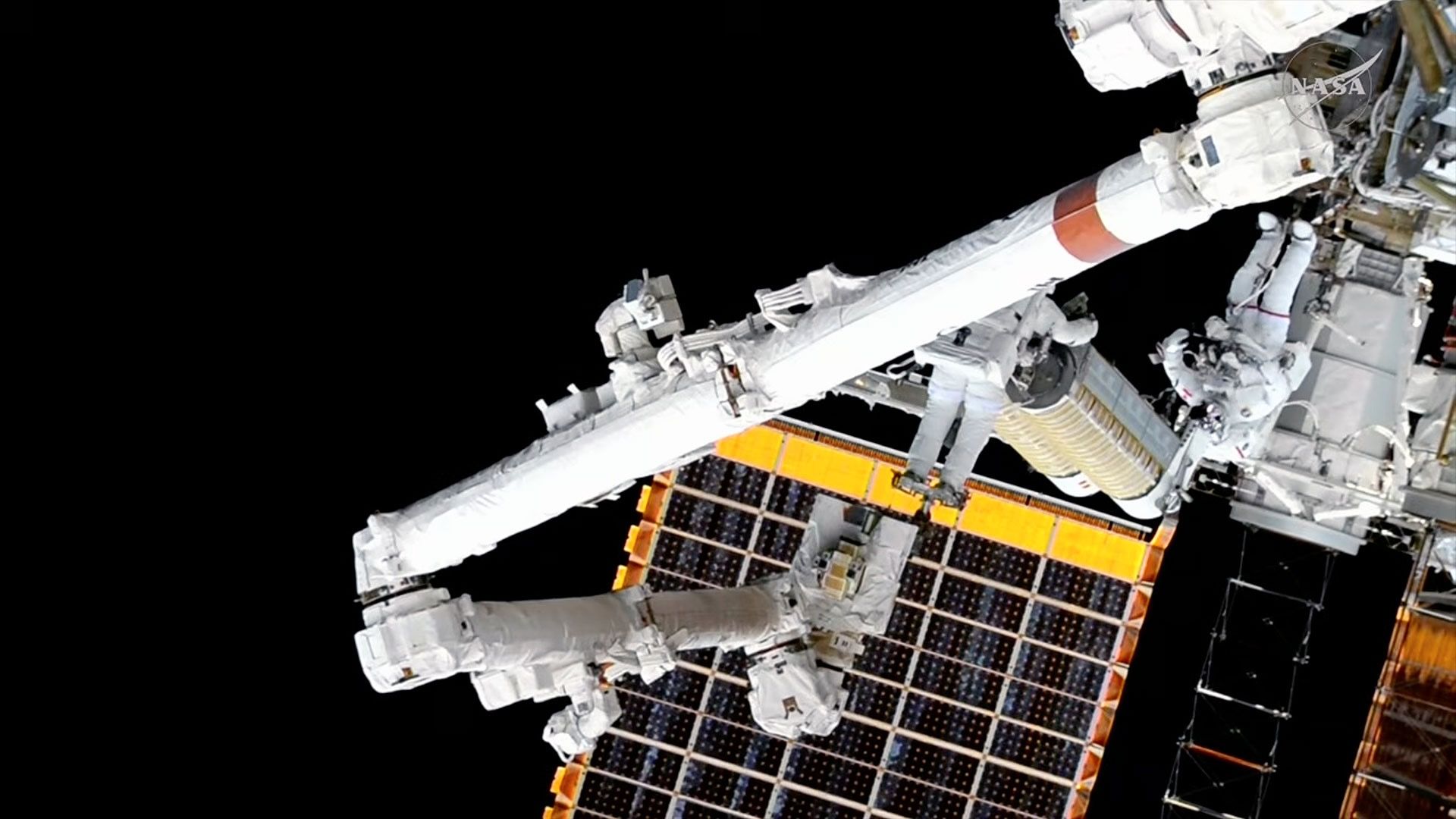
Expedition 75 flight engineers Anil Menon of NASA and Joshua Kutryk of the Canadian Space Agency installed and deployed the eighth and final ISS Roll-Out Solar Array (iROSA) on Thursday (Nov. 5), augmenting the space station's legacy solar array wings to produce as much as 30% more electricity.
"We got it done!" said Menon at the end of the 6-hour-and-59-minute spacewalk. The EVA (extravehicular activity) began at 8:36 a.m. EST and ended at 3:35 p.m. EST (1336 to 2035 GMT).
Repeating many of the same tasks as they did on an Oct. 29 spacewalk that added the penultimate iROSA, Menon and Kutryk worked this time on the starboard side of the station's backbone truss on the 3B power channel. The two retrieved the 750-pound (340 kilograms) iROSA assembly from a temporary stowage platform, carried it to the worksite by way of the Canadarm2 robotic arm and mounted it to its previously assembled bracket kit.
Menon then attached the cables to tie the iROSA into the station's systems but ran into a problem.
"We are seeing half of the expected shunt current that we want," radioed Nichole Stilwell, a NASA astronaut serving as the spacewalk officer in Mission Control. "In this current config, we are not necessarily going to deploy."
To address the issue, the connectors needed to be inspected. Out of safety concerns — given that the arrays generate electricity whenever lit by the sun — the astronauts needed to wait for the space station to enter the shadow of Earth to see what could be done. In the interim, they spent the time cleaning up their worksite and returning the Canadarm2 to its park site as they would have done after the deployment.
"We are seeing good shunt currents on the ground, so we are go for deploy," said Stilwell.
After releasing two bolts, Kutryk and Menon watched as the array started to unfurl to its full 63-foot (19 meters) length. No motor was needed; the iROSA, as designed, used only the potential energy stored by its rolled-up carbon composite booms to extend itself. The entire process took about 10 minutes.