// ARS TECHNICA — MODA & SOCIETÀ
Earth's churning mantle may have created the Great Unconformity
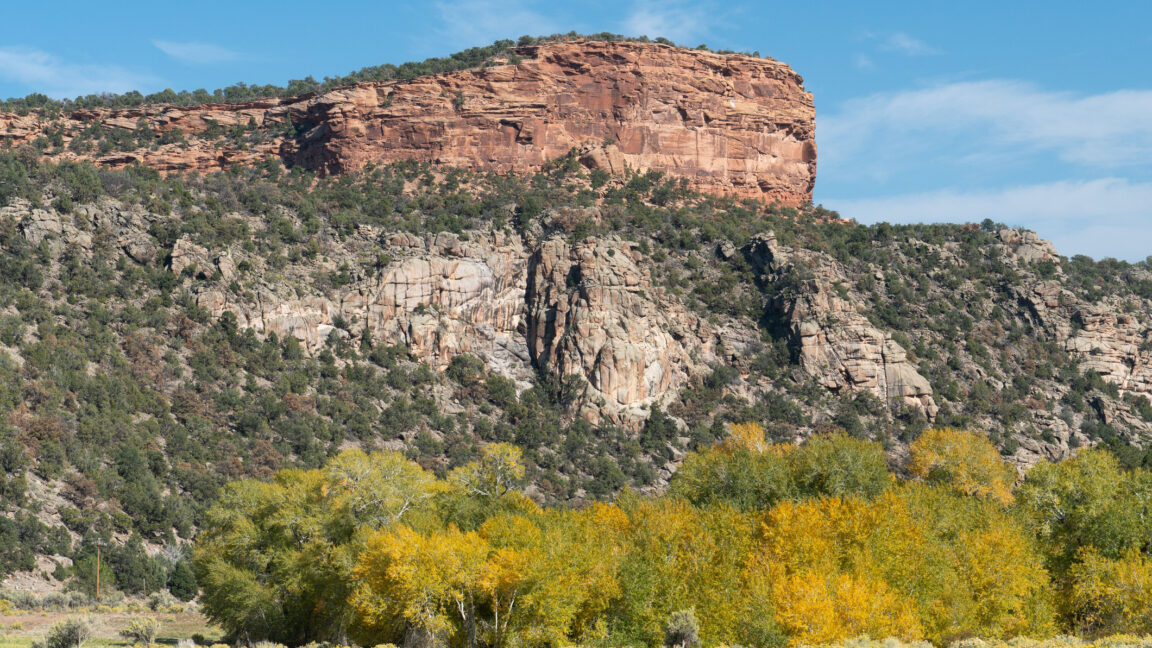
Explaining the Great Unconformity, where Cambrian deposits sit on top of older rocks.
In the Grand Canyon, there is a line in the rock where time seems to have gone missing. Ancient crystalline rocks mark its bottom, while sandstones laid down as life started to diversify during the Cambrian explosion mark the top. “It’s called the Great Unconformity, and it’s a gap in the geologic record,” says Nicolas Flament, a geoscientist at the University of Wollongong, Australia. “This gap can be anywhere between 200 million years, which is not that impressive, to more than a billion years.”
In a recent Nature study, Flament and his colleague Santosh Dhungana argue that this gap was carved with help from deep within the planet. According to their models, slow currents of hot rock in Earth’s mantle pushed entire continents up for hundreds of millions of years, letting glaciers grind them down and then let them sink, allowing fresh sediments to bury the scar. The largest hole in the rock record might be a fingerprint of processes happening deep in the planet’s interior.
The oldest sediments resting on the Great Unconformity in North America are between 635 and 482 million years old. Geologists have traced it across most of North America and parts of northern Europe and northern China. “Something seems to have happened, in particular in North America,” Flament says.
The leading explanation was glaciation. Between roughly 720 and 635 million years ago, glaciers reached the tropics, and some scientists think the entire planet froze over, a scenario called Snowball Earth. “Ice sheets are very good at grinding, scouring, scraping the surface,” Flament explains. He said that glaciers are about 10 times more effective than rivers at eroding rock away. But if the whole planet froze, the Great Unconformity should be found everywhere. And it’s not.
Other explanations included rifting, pulling and stretching of Earth’s crust, and a global drop in sea levels. But rifting acts mostly on the edges of continents, and a sea level change should have affected all continents alike. “There’s no doubt that there was extensive glaciation. There’s no doubt that there have been sea-level changes throughout time. The question is, was that enough to put the Great Unconformity puzzle together?” Flament says.
A fourth idea held that the mantle itself was moving continents up and down, a process called dynamic topography. “It had been proposed, but it hadn’t been quantitatively tested,” Flament says. So, his team set out to do so.
From roughly 100 to 200 kilometers beneath the surface down to nearly 3,000 kilometers, Earth’s mantle slowly convects. “An analogy would be a lava lamp, where some stuff comes up and some stuff comes down,” Flament explains. “Cold rock sinks and hot rock rises.”
The mantle is solid, yet a piece of rock can slowly travel from the surface to the deep Earth over some 200 million years. That motion tugs on the surface. Where cold slabs of ocean floor sink into the mantle at subduction zones, the ground gets pulled down; where hot mantle rises, it gets pushed up. The amplitude of this up and down motion is still debated, though. “The short of it is several hundreds of meters, and it’s still to be worked out exactly what that [precise value] is,” Flament says.
Dhungana and Flament ran six simulations of mantle convection going back 1 billion years, driven by reconstructions of how tectonic plates moved over that time. Then they grouped regions where the ground rose and fell in similar ways to find where the unconformity should have formed, and where it should have survived to the present. Flament, however, says the starting configuration of these simulations remains uncertain.