// TOM'S HARDWARE US — HARDWARE & GADGET
Going deep on local AI performance benchmarking with Apple’s Mac Studio with M5 Ultra taking on Nvidia DGX Spark
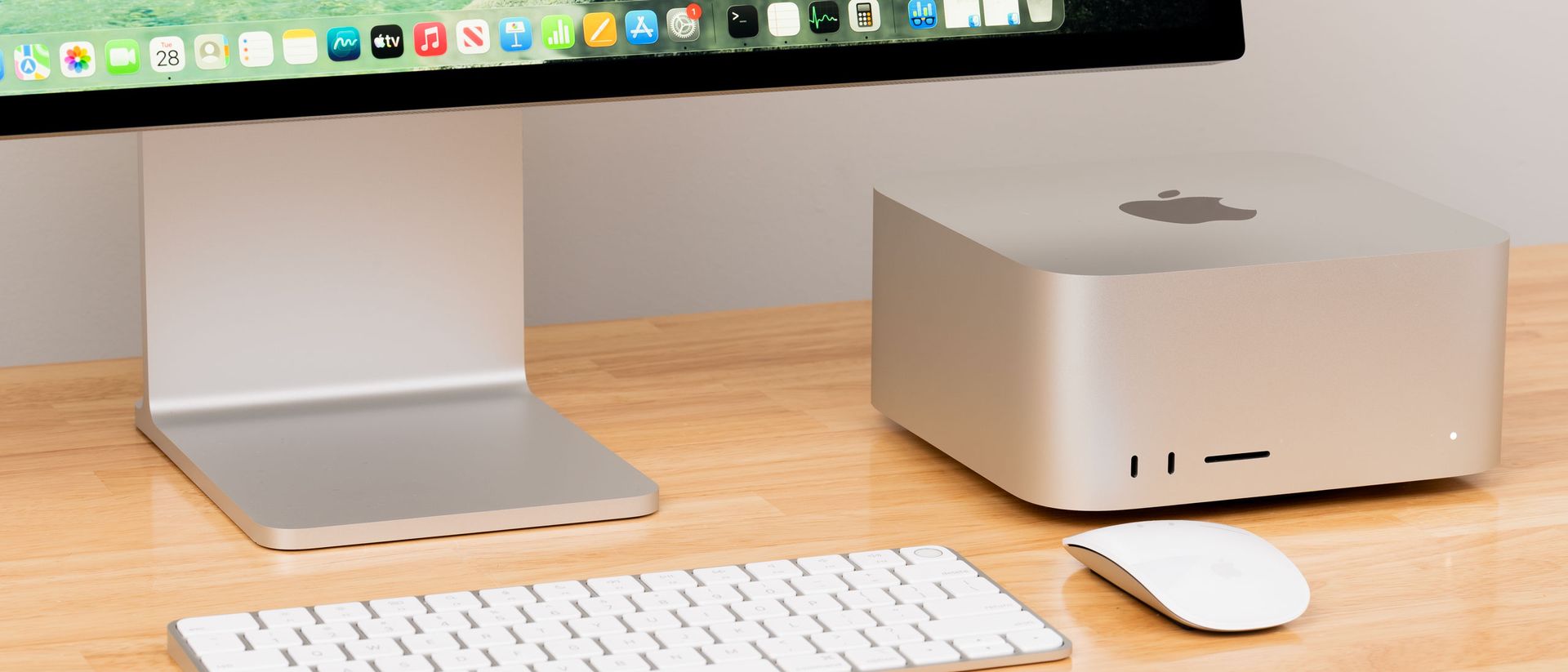
Is a Mac Studio a better investment than a DGX Spark?
When you purchase through links on our site, we may earn an affiliate commission. Here’s how it works.
Apple’s updated Mac Studio with the M5 Ultra SoC has already proven itself as one of the most powerful systems around, thanks to its 36-core CPU and 80-core GPU with Neural Accelerators for the matrix math operations that drive AI compute. Beyond that raw power, options for up to 512GB of unified memory have many local AI enthusiasts lining up for the 13 to 15 weeks it’ll take for Apple to ship one right now.
But is our tested Mac Studio config worth a whopping $12,300 or more for those folks? We already tested the maxed-out M5 Ultra chip with the popular Qwen 3.8 27B in our initial review, but that compact dense model doesn’t come anywhere close to exercising 256GB of memory. We wanted to fill that pool to the brim with cutting-edge large models like DeepSeek V4.1 Flash 1017 and GLM 5.3 Flash.
We also have some new benchmarks at our disposal to see how the Mac Studio stacks up in agentic tasks on the GPU side in the wake of our review of the Microsoft Surface Laptop Ultra with Nvidia’s RTX Spark chip. So there's much to dig into.
We started our more detailed local AI testing with Artificial Analysis' AgentPerf-Local benchmark. This test plays back recorded inference traces with certain models across a range of agentic AI workloads to gauge performance. Artificial Analysis provides a full breakdown of this workload, but the bulk of its work takes place in prompt processing rather than token generation. As a result, it should favor systems with lots of raw compute, which both GB10 and the M5 Ultra have at their disposal.
The M5 Ultra's 80-core GPU dwarfs GB10's 48 Blackwell SMs at a high level. Even without detailed info on clocks, it would be extremely difficult for GB10 to outgun the M5 Ultra in this test. And the Mac's 1.2 TB/s of memory bandwidth gives it just over four times as much decode bandwidth as GB10's 273 GB/s. But as our past tests have shown, raw specs aren't as important as delivered performance with AI. Delivered performance can vary greatly from paper specs.
We continued to use the dense Qwen 3.8 27B for this test. We used llama.cpp as our inference backend on both the Mac Studio and a single Dell Pro Precision GB10 box, which is nearly identical to the DGX Spark. We further enabled Qwen 3.8 27B’s native multi-token prediction (MTP) support for a decode speed boost on both platforms.
Versus a single DGX Spark-like system, the M5 Ultra Mac Studio finishes this agentic test in just under half the time, an extremely impressive result. One might think this is a silly comparison given the imbalance in compute resources and memory bandwidth between these two systems, but the cost of a single 4TB Dell Pro Precision GB10, like the one we tested, is now a whopping $10K, so comparing it to the $12K Mac Studio head-to-head isn’t actually that far-fetched.
Because AgentPerf-Local performs a fixed amount of work on every system, we can also directly compare power efficiency between platforms by recording the wall power consumed by a single Spark and the Mac Studio and converting it to task energy in kilojoules.