// NATURE NEWS — SPAZIO & SCIENZA
Validation of clinical and preclinical obesity across global cohorts
Nature
(2026) Cite this article
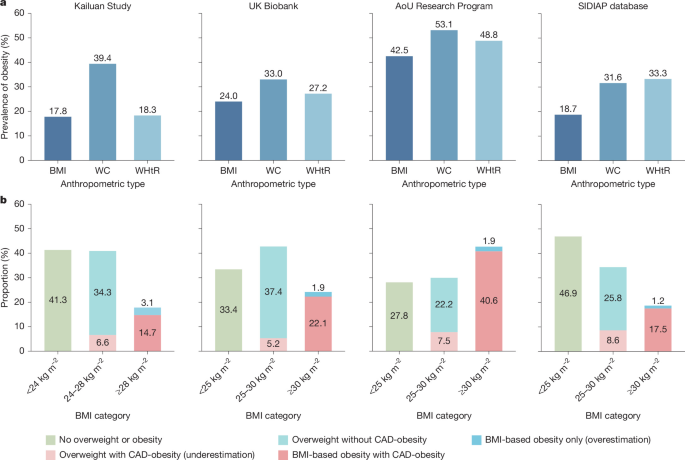
In 2025, a Lancet Commission proposed distinguishing clinical obesity, defined by adiposity-related organ dysfunction, from preclinical obesity, defined by excess adiposity with preserved function, and recommended using anthropometric measures beyond body mass index (BMI) to confirm obesity status1. Here we report the comparative performance of this framework versus conventional BMI-based classification using prevalence, incidence and mortality data from 844,108 adults across four cohorts in China, the UK, the USA and Spain. Complementing BMI with waist circumference and waist-to-height ratio data showed that BMI alone overestimated obesity in 1.2–3.1% and underestimated it in 5.2–8.6% of participants across cohorts. The combined anthropometric definition increased overall obesity prevalence by 3.3–7.4% relative to BMI-based classification. Clinical obesity accounted for 22.7–31.3% of total obesity, with an overall population prevalence of 5.6–10.9%. A large proportion of individuals (between 77.4% and 91.3%) with preclinical obesity at baseline showed no progression to clinical obesity over 10 years. Increased mortality risk was associated with the combined anthropometric definition of obesity, but not with BMI-only obesity. Clinical obesity was associated with substantially higher all-cause mortality (hazard ratio 1.69, 95% confidence interval 1.64–1.73), whereas preclinical obesity conferred only modest risk (1.19, 1.14–1.24). These findings support the global adoption of the Lancet Commission diagnostic framework to improve obesity care and policy.
Medical diagnoses typically define disease on the basis of objective signs of organ dysfunction2 (see https://www.merriam-webster.com/dictionary/diagnosis). By contrast, the health impact of obesity has historically been assessed using body mass index (BMI)—a proxy for body size—alongside obesity-related comorbidities3,4,5. This approach provides an aggregate measure of ill health rather than a disease-specific diagnosis.
The absence of a clinically grounded definition has impeded recognition of obesity as a distinct disease, contributing to gaps in care, inconsistent prevention, misallocated resources and persistent stigma6,7.
To address this, in 2025, a Lancet Commission from The Lancet Diabetes & Endocrinology proposed a new diagnostic framework that distinguishes between two categories of obesity: clinical obesity, defined by excess adiposity impairing organ function or daily activities; and preclinical obesity, characterized by increased adiposity and increased health risks but with preserved organ and whole-body function1. The framework also recommends supplementing BMI with other anthropometric measures, such as waist circumference (WC), waist-to-height ratio (WHtR) or fat quantification with dual-energy X-ray absorptiometry, when available, to improve the detection of excess adiposity. Although consistent conceptually with diagnostic principles in medicine, the clinical implications of this framework remain uncertain. It is unknown how substantially the recommended use of additional anthropometric measures changes the classification of obesity compared with BMI alone, or whether the distinction between clinical and preclinical obesity captures meaningfully different health states. The natural history of preclinical obesity is also poorly characterized, including the extent to which it remains stable or progresses to clinical obesity over time. More broadly, whether these classifications show consistent associations with prognosis across populations and healthcare settings has yet to be established. We examined these questions using data from 844,108 adults from four large cohorts in China, the UK, the USA and Spain, aiming to evaluate the Lancet Commission’s proposed diagnostic framework in terms of obesity classification, the distribution and longitudinal course of clinical and preclinical obesity and thei