// NATURE NEWS — SPAZIO & SCIENZA
Hadean mantle depletion and 3.95-Gyr subduction implied by North China rocks
Nature
(2026) Cite this article
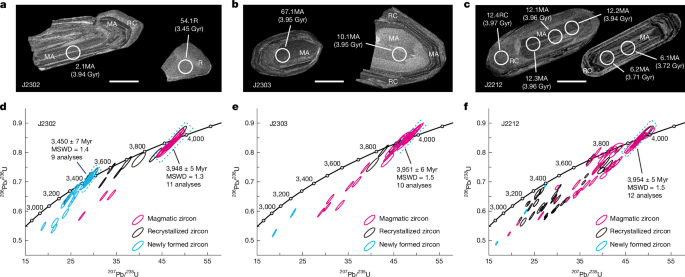
The scarcity of terrestrial rocks older than 3.9 billion years (Gyr) has hindered our understanding of Earth’s early evolution, fuelling persistent debates on how and when the first continental crust formed and plate tectonics started. At present, the only unequivocally documented >3.9-Gyr-old rocks are from the Acasta Gneiss Complex, Canada1,2,3. Here we report a 3.95-Gyr-old trondhjemitic gneiss from eastern Hebei, North China Craton, in which primary magmatic zircon records elevated δ18O values (average +6.77 ± 0.23‰) and positive εHf(t) values (weighted mean +1.45 ± 0.27). This suggests a low-temperature altered basaltic source that originated from a mantle depleted in the Hadean. In contrast to the low-pressure origin inferred for the roughly 4.0-Gyr-old Idiwhaa unit in Acasta2, the 3.95-Gyr-old trondhjemitic gneiss reported here exhibits geochemical signatures attributed to a high-pressure origin4. Thermodynamic and trace element modelling demonstrate that its parental magma formed by means of low-degree (8–16%) melting of basaltic crust at >1.6 GPa and 740–820 °C, suggesting rapid burial of (near-)surface-altered oceanic crust to mantle depths along a cool thermal gradient. We propose that this rapid burial was most likely achieved through a transient subduction event.
This is a preview of subscription content, access via your institution
Access Nature and 54 other Nature Portfolio journals
Get Nature+, our best-value online-access subscription
Prices may be subject to local taxes which are calculated during checkout
All data are available in the supplementary tables of this manuscript. These tables are available in the Zenodo repository (https://doi.org/10.5281/zenodo.22911249; ref. 93). Source data for the figures are provided with this paper.
Bowring, S. A. & Williams, I. S. Priscoan (4.00–4.03Ga) orthogneisses from northwestern Canada. Contrib. Mineral. Petrol. 134, 3–16 (1999).
Article
CAS
Google Scholar
Reimink, J. R., Chacko, T., Stern, R. A. & Heaman, L. M. The birth of a cratonic nucleus: lithogeochemical evolution of the 4.02–2.94 Ga Acasta Gneiss Complex. Precambrian Res. 281, 453–472 (2016).