// NATURE NEWS — SPAZIO & SCIENZA
Mitochondrial protein import defects enhance tumour immunogenicity
Nature
(2026) Cite this article
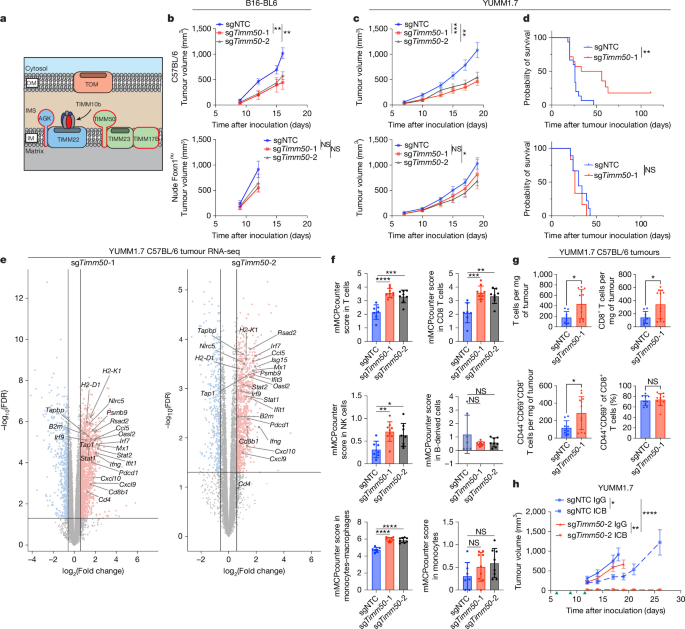
Tumour cells evade detection and elimination by the immune system through a suite of adaptations1, including the repression of antigen presentation, which is required for the recognition of tumour cells by CD8+ T cells. Mitochondria have emerged as targets for enhancing antitumour immunity; however, the extensive mitochondrial proteome has remained largely unstudied for its ability to modulate immune responses. Here we show that defects in the mitochondrial protein import machinery promote tumour immunogenicity and synergize with immune checkpoint blockade treatment in melanoma models. Mitochondrial protein import perturbation, specifically through depletion of the TIM23 import complex subunit TIMM50, enhances tumour immunogenicity through a pathway involving mitochondrial DNA escape, cGAS–STING pathway activation and interferon-β (IFNβ) secretion. Secreted IFNβ signals through the type I IFN receptor to activate the JAK–STAT pathway, resulting in increased antigen presentation on MHC class I complexes. Mitochondrial DNA escape in Timm50-depleted cells is linked to the formation of mitochondrial-derived vesicles. Depletion of SNX9 and RAB9, involved in mitochondrial-derived vesicle formation2, suppresses mitochondrial DNA-dependent type I IFN production and signalling. By disrupting mitochondrial proteostasis and membrane architecture, defective protein import in Timm50-depleted cells drives the immune phenotype. This study shows that mitochondrial protein import inhibition causes tumour immunogenicity, including sensitization to immune checkpoint blockade, by promoting mitochondrial DNA escape and IFNβ-driven MHC class I antigen presentation.
This is a preview of subscription content, access via your institution
Access Nature and 54 other Nature Portfolio journals
Get Nature+, our best-value online-access subscription
Prices may be subject to local taxes which are calculated during checkout
Proteomics data have been deposited to the Proteomics Identifications Database (PRIDE) under the accession number PXD069846. RNA-seq data have been deposited to the Gene Expression Omnibus (GEO) under accession numbers GSE347225 (RNA-seq of YUMM1.7 tumours inoculated in C57BL/6 mice) and GSE320547 (RNA-seq of B16-BL6 and YUMM1.7 cells cultured in vitro). Processed datasets for RNA-seq, proteomics and metabolomics are available as Supplementary Tables. Uncropped blots are provided in Supplementary Fig. 1. For proteomics analysis, the mouse reference proteome (UP000000589) was downloaded from Uniprot in May 2023. The mouse reference genome GRCm39 was used for mapping of RNA-seq reads. Source data are provided with this paper.
Galassi, C., Chan, T. A., Vitale, I. & Galluzzi, L. The hallmarks of cancer immune evasion. Cancer Cell 42, 1825–1863 (2024).
Article
CAS
PubMed
Google Scholar
König, T. & McBride, H. M. Mitochondrial-derived vesicles in metabolism, disease, and aging. Cell Metab. 36, 21–35 (2024).