// SPACE.COM — SPAZIO & SCIENZA
1 light-day from Earth! NASA's Voyager 1 probe hits huge milestone in interstellar space
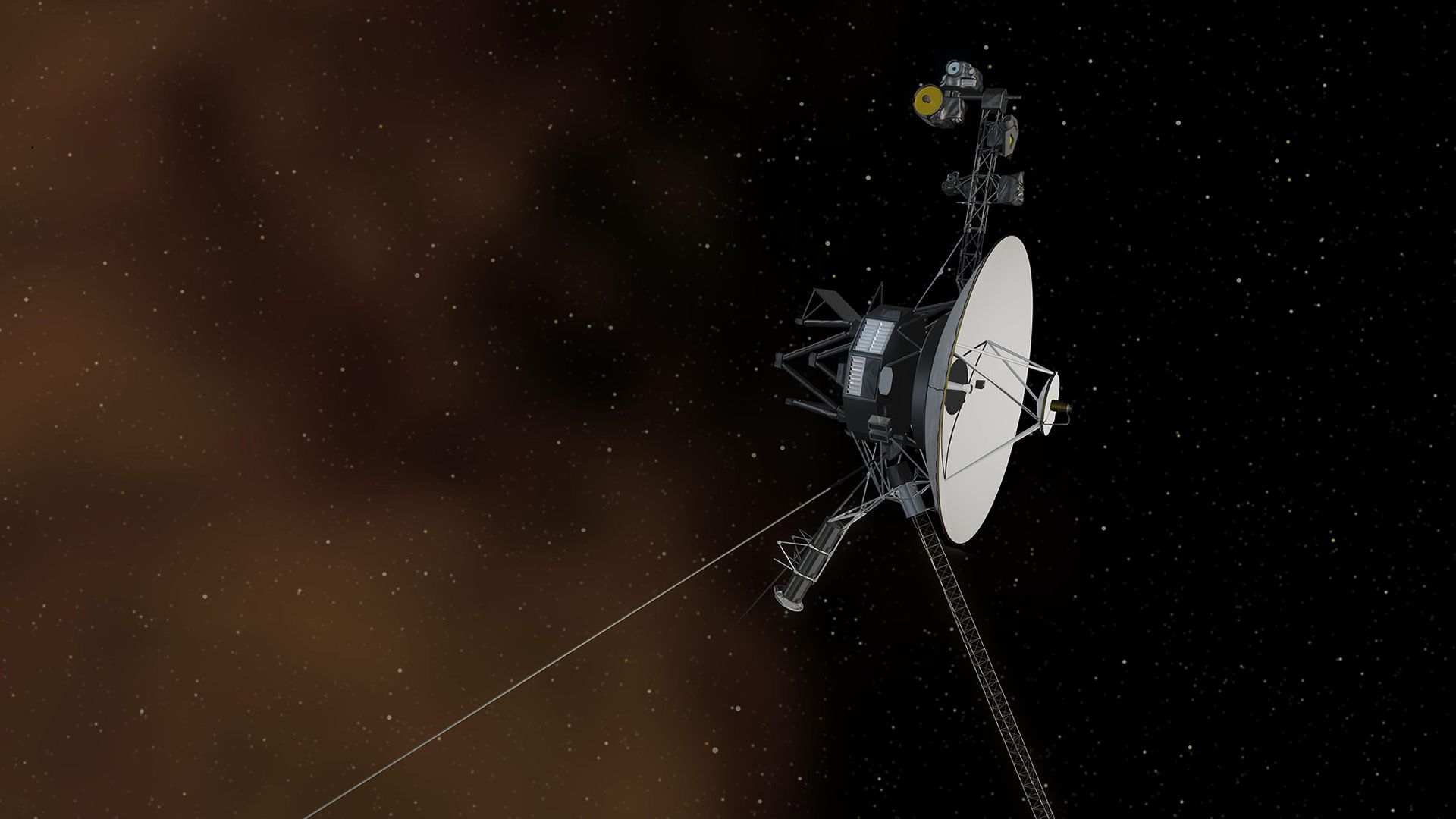
It now takes 24 hours for even a single particle of light to reach Voyager.
When you purchase through links on our site, we may earn an affiliate commission. Here’s how it works.
NASA's Voyager 1 spacecraft is now one light-day from Earth — so far away that it takes signals a full 24 hours to reach the probe.
Voyager 1 launched on Sept. 5, 1977, just a couple of weeks after Voyager 2 lifted off. But Voyager 1 launched on a faster trajectory than its twin and has just become the first spacecraft to ever reach one light-day away, which is equivalent to about 16 billion miles (about 26 billion kilometers), or the distance that one light particle travels in 24 hours. The milestone — which Voyager 1 hit today (Nov. 18) at 5:16 a.m. EST (1016 GMT) — shows the incredible ingenuity, technical ability and creativity from the teams at NASA that continue to innovate to keep this mission going nearly five decades later.
"The Earth and Voyager are exactly 24 hours apart at the speed of light," Voyager Project Scientist Linda Spilker told Space.com. "It's a very special moment where Voyager 1 is about 16.1 billion miles away, and we're celebrating that moment because it's the first human-made object to actually reach one light-day distance."
The two Voyager spacecraft have been on one serious ride since launching in 1977. And each of these twin probes has taken a unique and historic journey through our solar system and beyond.
On Voyager 1's trip through our cosmic neighborhood, for example, it made countless groundbreaking observations of planets and moons that we had never before seen up close (or at all). The probe discovered a ring around Jupiter as well as the planet's moons Thebe and Metis. It also found five new moons and a new ring around Saturn.
"Voyager 1 flew past the Jupiter system and took images of Jupiter's moon Io, and it actually discovered that Io is volcanically active. So, images that were taken showed these volcanoes that were actively erupting, and we learned that Io is actually the most volcanically active body in our solar system, which is just amazing," Cynthia Phillips, a project scientist for NASA's Europa Clipper mission, told Space.com about one of Voyager 1's many discoveries.
"And then, as Voyager 1 continued out to the Saturn system, it actually discovered that Saturn's large moon Titan has a very thick atmosphere surrounding it," she added. "So it's one of the only moons that has a thick atmosphere."
Decades later, Voyager 1's data is still incredibly important for scientists studying the planets and moons of our cosmic neighborhood. Phillips works on Clipper, which is on its way to study Jupiter's ocean moon Europa. And the basis of that work stems from early observations by Voyager.