// NATURE NEWS — SPAZIO & SCIENZA
Quantum resistance paradox of low-dimensional superfluids
Nature
(2026) Cite this article
Resistance in standard conductors decreases with increasing cross-section. Yet, in low-dimensional superconductors and superfluids, residual resistance arises from topological fluctuations of the order parameter, manifesting as phase slips in one-dimensional (1D) and vortices in two-dimensional (2D) systems. How resistance and dissipation evolve as geometry interpolates between these regimes remains an open question. This evolution is masked in solid-state experiments by disorder, impurities and geometric imperfections1,2,3, and poses theoretical challenges due to competing dissipative processes and pronounced finite-size effects. Here, we use a defect-free unitary Fermi gas in a digitally programmable transport geometry to isolate geometric effects on superfluid dissipation and discover a paradox: in the crossover from one dimension to two dimensions, the resistance reaches a minimum. There, widening a channel increases its resistance. Narrower, quasi-1D channels show dissipation described by Langer–Ambegaokar–McCumber–Halperin theory of phase slips4. In this regime, varying the channel width yields the predicted exponential scaling of the activation factor over many orders of magnitude. Wider, quasi-2D channels show dissipation consistent with phase-slip events described by a finite-size vortex model5. The minimal dissipation in the dimensional crossover reflects a transition in the dominant dissipative mechanism, with both 1D and 2D events simultaneously suppressed. Our measurements suggest a route to minimizing dissipation in superconducting devices and provide a benchmark for theoretical efforts aimed at describing the dimensional crossover.
The Landau model provides a powerful framework for understanding many phases of matter through the lens of spontaneous symmetry breaking6,7. In superfluids and superconductors, this breaking manifests in the emergence of a macroscopic condensate that exhibits long-range phase coherence. This coherence is ultimately responsible for properties such as dissipationless transport8,9, the Josephson effect10, and in the case of superconductivity the Meissner effect11. Although relatively robust in bulk systems, in lower-dimensional systems, the enhanced effect of fluctuations—and in particular topological defects—can suppress this long-range phase coherence and govern superfluid transport4,12.
For example, in a voltage-biased superconducting wire, the applied voltage continuously winds the superconducting phase, causing an increase of the phase gradient between the contacts. The supercurrent, proportional to this gradient, would grow without bound unless intermittent phase fluctuations relax the accumulated gradient. By relaxing the gradient, the fluctuations dissipate energy, thereby causing a resistance3,13. The characteristics of the fluctuations and their corresponding resistance depend on the dimensionality of the setup as follows.
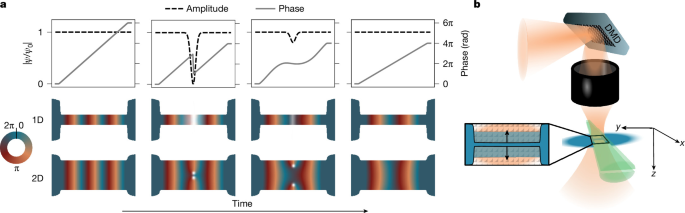
In one-dimensional (1D) wires, discrete relaxation events known as phase slips dominate the dynamics. Microscopically, a phase slip occurs when the magnitude of the superconducting order parameter is transiently and locally suppressed over a healing length ξ. Where the amplitude vanishes, the phase is ill-defined, allowing for phase jumps of 2π. As the order parameter recovers, the wire returns to a state with a uniform amplitude but a reduced phase gradient4 (Fig. 1a, top row).
a, Dissipation in a narrow, quasi-1D channel occurs because of phase slips, in which a depletion of the order parameter allows for a relaxation of the phase gradient and kinetic energy (top row). The corresponding phase (colour-coded) evolution of a phase slip in a narrow channel is plotted in the central row. In a wide, quasi-2D channel, dissipation is governed by vortex–antivortex pairs traversing the channel (bottom row). b, A transport channel of programmable width connects two superfluid reservoirs (blue). The chan