// ARS TECHNICA — MODA & SOCIETÀ
2026 Volkswagen Jetta Sport: The cheap car isn't completely extinct yet
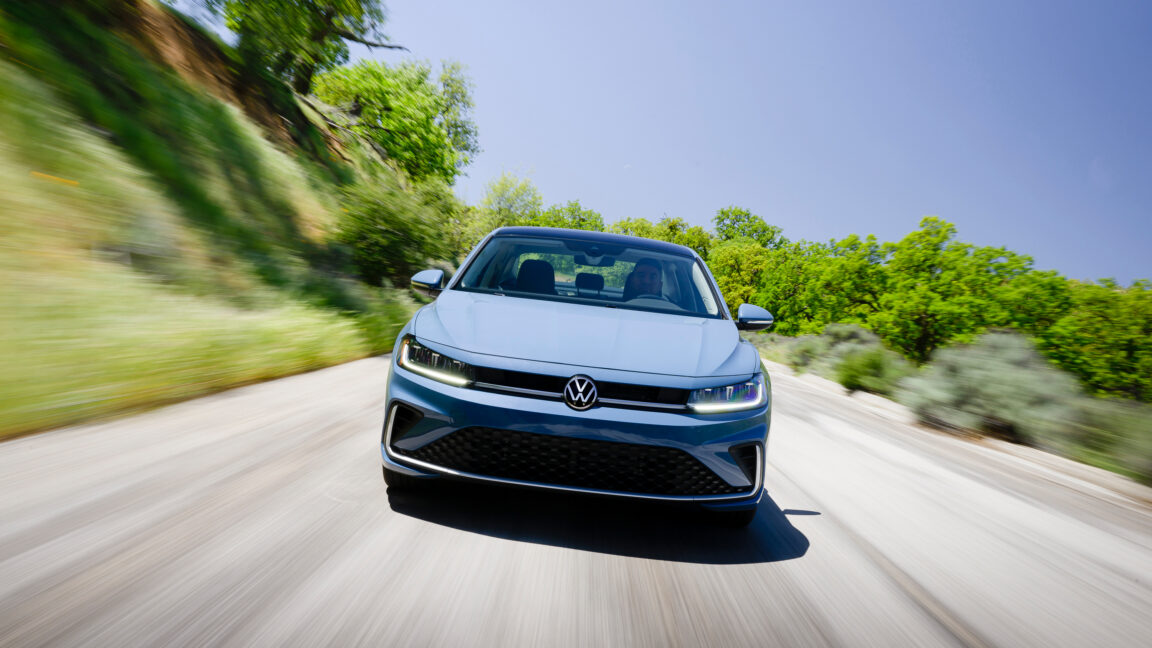
At $25,305, you won’t find many new cars for less. But you get what you pay for.
As so many career counselors and lifestyle coaches have explained, first impressions matter. A bad one can set the tone for an entire relationship, whether that’s with a person, a novel, a restaurant, or a car. And the 2026 Volkswagen Jetta Sport and I did not get off to the best of starts.
Picture the scene: You’ve been at home for a total of one night out of the previous eight, and you’ve just landed at the airport after an eight-hour flight. It’s 85˚F (30˚C) and raining. You could take the metro home. Sure, 80 minutes isn’t quick, but all you have to do is sit there, then walk home a block. But you can’t because there’s a car to be reviewed, waiting to be driven home. In rush hour.
I will confess, I did not know VW made a Jetta Sport. For one thing, it’s not the Jetta GLI. That car has plenty of power and torque and uprated suspension, and it can even be ordered with a six-speed manual, unlike the Golf GTI, although based on our most recent GLI drive, you may regret ticking that particular box.
There’s no special engine under the hood here, just the same 1.5 L four-cylinder turbo like all the other Jettas, running on VW’s modified version of the Miller cycle, where the intake valves close earlier than most engines during the suction stroke to boost efficiency. At 11.5:1, the compression ratio is quite high, even for a more modern turbocharged engine, but it helps generate 158 hp (118 kW) and 184 lb-ft (250 Nm), all of which goes to the front wheels via an eight-speed automatic transmission.
On that first hot, rainy afternoon, the power and torque delivery left a lot to be desired. There are no sport or eco modes, just one throttle map for all situations. And below 2,500 rpm, the engine was easy to modulate on a part-throttle. But keep that part-throttle and let the revs past that threshold, and the combination of gearing and turbocharger throws a giant slug of torque at the road, making you look like a moron who shouldn’t be allowed out in public as the car lurches and accelerates faster than you planned.
That initial drive took even longer than the metro would have due to road closures and construction. Learning how to modulate the throttle in heavy traffic wasn’t helped by an alert that sounded every time I exceeded 20 mph, warning me about winter tires. The car was not, in fact, on winter tires, but I crossed that speed threshold plenty of times as I crept along I-66. The following day, a quick read through the manual revealed how to disable that alarm, though it offered no advice on smoothing out the power delivery.
Even after days, this truculent response to being driven gently remained, although it could be partially ameliorated by leaving the transmission in S rather than D. This holds each gear longer, leaving you at the mercy of the throttle map and turbocharger, albeit with a concomitant hit to fuel economy because the gearbox won’t shift to the next ratio so soon.
By Friday, I was thoroughly underwhelmed with the Jetta Sport and ready for it to be gone.
My decision to take the Jetta Sport to Cars and Coffee on Saturday morning was not entirely mean-spirited. In fact, it turned out to be revelatory. Traffic was unusually absent, and the roads were abnormally cambered and twisty. Taken by its scruff, the Jetta showed a different character. And I’m not talking ten-tenths tire squealing, either. But using the transmission in manual mode—pushing it to change up a gear and pulling it toward you to downshift, the opposite of a real sequential shifter—lets you keep the engine out of the “nothing, nothing, nothing—WHOA” section of the power band. It’s not particularly fast at changing gears, but it works.