// SPACE.COM — SPAZIO & SCIENZA
Sun-like star may have swallowed an exoplanet with help from a mysterious companion: 'You are what you eat, right?'
"That's what makes this field so exciting. You really are solving a mystery."
When you purchase through links on our site, we may earn an affiliate commission. Here’s how it works.
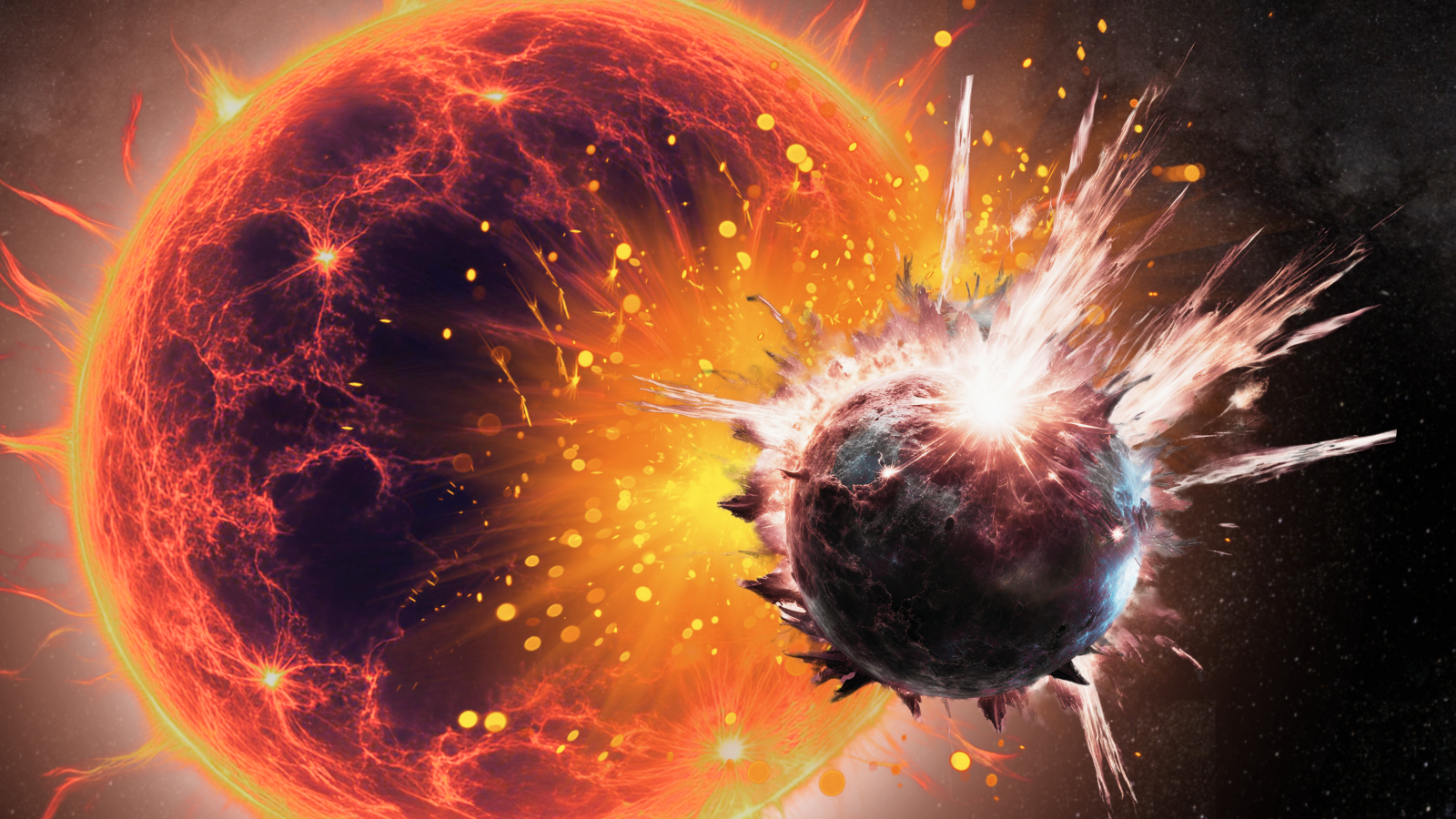
Astronomers have a cosmic mystery on their hands, investigating a celestial crime scene to determine if a distant star has eaten a super-Earth exoplanet. The star may have had an accomplice — a failed star or "brown dwarf" companion — which may have steered the unfortunate planet toward its fiery doom.The team charged with investigating this mystery first discovered hints of the crime when they found the star, TOI-5882, located around 1,300 light-years away, is surprisingly rich in the element lithium. "You are what you eat, right?" team leader Brooke Kotten of the University of Michigan said in a statement. "We know that there's much more lithium in planetary material than there is in stars. So if a star eats a planet, it's going to take on a bunch of lithium."
So-called engulfment events such as this one occur very rapidly, on a timescale of a few days to a couple of weeks, which means catching stellar beings in the act of enjoying a planetary meal is extremely rare. Thus, astronomers have to act as cosmic crime scene investigators to reconstruct these events with the evidence at hand.
"That's what makes this field so exciting. You really are solving a mystery," Kotten said. "We can't just watch the crime happen, so we have to work with all the clues we're given to figure out whodunit."
One of the aims of these investigations is to discover the ways in which a star can devour a planet. One of the most common engulfment scenarios happens when a star runs out of hydrogen at its core at the end of its main sequence lifetime. This results in it swelling out to up to 100 times its original diameter, engulfing its attendant planets during its so-called red giant phase. This will occur in the solar system in around 5 billion years when the sun will puff out to around the orbit of Mars, swallowing the inner rocky planets, including our own.
However, Kotten and colleagues know this isn't what has happened in the TOI-5882 system, as this star hasn't yet become a red giant. Instead, the researchers think the sun-like star had assistance from its brown dwarf companion.
Brown dwarfs get their slightly unfortunate nickname of "failed stars" because, despite forming from collapsing clouds of gas and dust, just like stars, they fail to grow to the masses needed to trigger the nuclear fusion of hydrogen to helium in their cores, the process that defines what a main-sequence star is. They're quite mysterious by existing in this sort of limbo between planet and star.
This particular brown dwarf has around 20 times the mass of Jupiter, or around 2% of the mass of the sun. That's not massive enough to trigger nuclear fusion, but is massive enough for it to have enough of a gravitational influence over planets orbiting TOI-5882. That means the team suspects this brown dwarf could have perturbed the orbit of this unfortunate planet enough to send it plummeting into its star.
This is something the scientists will need to investigate further. They may not have enough information yet to determine this planet's cause of death, but they do have some evidence that helps them identify the kind of world it would have been before it was obliterated. This comes from observations of the chemical composition and lithium content of 62 stars with similar ages and masses to TOI-5882.