// ARS TECHNICA — FINANZA
Mount Toba eruption doesn't seem like it could nearly kill our species
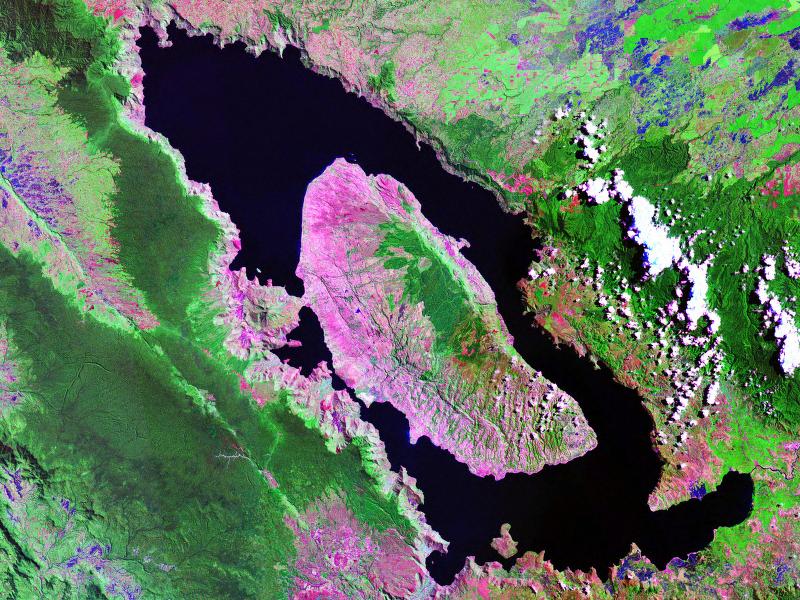
The massive Toba eruption seems to have had little climate impact.
Mount Toba was the biggest volcanic eruption in the last 2.6 million years, and some have suggested it nearly wiped out humanity. Around 74,000 years ago, a caldera on what is now Sumatra emptied thousands of cubic kilometers of magma in about two weeks, roughly a thousand times more than Mount Pinatubo spewed out in 1991. “People thought it might have caused massive cooling of the planet, and hence threatened the survival of our ancestors,” says Jinheum Park, a geoscientist at Johannes Gutenberg University in Mainz, Germany.
Park and his colleagues went looking for the records of that catastrophe in the mud taken from the bottom of a small crater lake on the Kenya-Tanzania border. They found instead that the effects of the Mount Toba eruption lasted under two years and amounted to perhaps half a degree of cooling.
Volcanic eruptions inject sulfur dioxide into the stratosphere, where it becomes a haze of tiny droplets that reflect sunlight back into space. Bigger eruptions eject more sulfur dioxide and, in principle, cause more cooling. But this trend stops working when the eruption exceeds a certain magnitude. “Bigger sulfate aerosols settle quickly, because they are heavier,” Park explains. This quick settling makes them less effective in scattering incoming solar radiation.
Estimates of Toba’s sulfur output varied so widely that computer models had the eruption appearing as anything between a near-extinction-level event to a mild nuisance for our early ancestors, depending on the number we punched in. To settle this argument, scientists tried to look at geological evidence: Toba’s ash preserved in seafloor or lake cores. But this also proved tricky.
Underwater mud cores usually don’t work that well when it comes to dating and constraining abrupt, violent events like volcanic eruptions. When sediment settles at the lake or ocean bottom, materials from different years get a bit mixed. Even if we cut a mud core taken from the bottom of the sea into very thin slices and attempt to resolve climate changes at smaller intervals, our slices would reflect the mixed influence of yearslong climate signals. With most such records, we can track how past climates evolved decade by decade. A volcanic winter, even a severe one, would last one to three years.
“It’s really difficult to find any sedimentary archive which registers the regional climate at such high resolution,” Park says. Looking for traces of a Toba catastrophe in standard sediment cores was like timing a sprint with a calendar. But then scientists found a lake with sediment records that worked more like a stopwatch.
Lake Chala is a small, steep-walled crater lake on the flank of Mount Kilimanjaro, fed by groundwater from the mountain’s forested slopes. Its deep water never fully turns over, leaving the bottom starved of oxygen and free of currents. This makes it a nearly perfect hi-res climate recorder, in which sediments are deposited as varves: annual couplets with a light-colored layer rich in silica skeletons from algae called diatoms and a dark-colored layer with fine-grained soils and clays. “It works just like tree rings,” Park says.
The couplets exist because from October through April, the water stays layered and still as the dark materials accumulate. Then, in the cool, dry, windy months from June to September, it mixes. “The lake is 90 meters deep, but during cool and dry conditions the water can be mixed down to about 50 meters,” Park explains. “In that case, the nutrients near the lake bottom come up to the surface, and then the diatoms can make use of them.” Diatoms, fed by that upwelling material, bloom, die, and sink as a pale layer of silica—a layer that’s thicker in cool, dry years when the mixing season runs long.
Toba’s ash at Chala was identified by earlier work. It is invisible to the naked eye, its particles too sparse and small to form a visible layer. Scientists found them by