// NATURE NEWS — SPAZIO & SCIENZA
In situ particle-to-fibre transformation of hydrogels for 3D printing
Nature
(2026) Cite this article
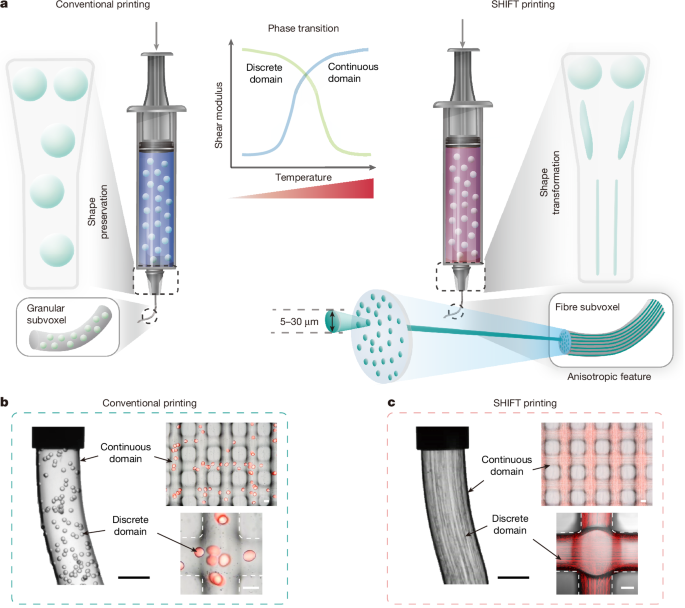
Structural anisotropy is ubiquitous in nature and governs orientation-dependent properties and functions1,2. Recreating biomimetic anisotropy in hydrogels—water-rich soft materials widely used in biomedicine—has proven challenging3. Here we report a phenomenon termed shear-extensional in situ particle-to-fibre transformation (SHIFT) and demonstrate the SHIFT printing of highly aligned hydrogel microfibres (5–30 μm in diameter). In SHIFT, particle-embedded hydrogel is extruded in a controlled manner, in which the discrete particles and surrounding matrix experience opposite phase transitions, concurrently transforming particles into well-aligned subvoxel microfibres. SHIFT establishes a methodology for creating anisotropy from droplets, which is dominated by extensional flow of sol–gel two-phase systems. It constitutes a versatile upstream manufacturing approach that can be readily adapted into three-dimensional printing and microfibre spinning scenarios in a highly accessible manner. The pronounced structural anisotropy enables the formation of exceptionally long myotubes in vitro and accelerates regeneration in volumetric muscle loss. By implementing an in situ subvoxel manufacturing process within flow, SHIFT expands the ability to process soft materials.
This is a preview of subscription content, access via your institution
Access Nature and 54 other Nature Portfolio journals
Get Nature+, our best-value online-access subscription
Prices may be subject to local taxes which are calculated during checkout
The raw RNA sequencing data are available in the NCBI under accession number PRJNA1475823 . Source data are provided with this paper.
Sanchez, C., Arribart, H. & Giraud Guille, M. M. Biomimetism and bioinspiration as tools for the design of innovative materials and systems. Nat. Mater. 4, 277–288 (2005).
Article
CAS
PubMed
Google Scholar
Chen, J. et al. 3D-printed anisotropic polymer materials for functional applications. Adv. Mater. 34, 2102877 (2022).