// NATURE NEWS — SPAZIO & SCIENZA
A dependency map enhanced with next-generation 3D cancer models
Nature
(2026) Cite this article
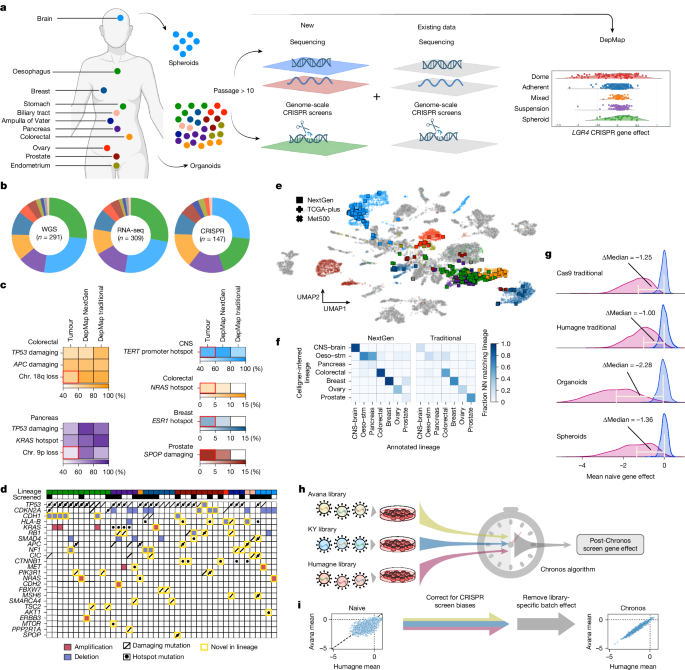
Despite advances in precision oncology, effective personalized treatments are still lacking for most patients with cancer1. The Cancer Dependency Map (DepMap) accelerates this field by systematically identifying cancer vulnerabilities in diverse preclinical models. Data from over 1,300 cell lines have led to the discovery of new therapeutic strategies across multiple tumour types2. However, mapping cancer vulnerabilities using traditional cell lines has limitations, including insufficient cancer subtype representation and the impact of culture conditions on perturbation responses. Here we perform 147 genome-scale CRISPR screens and multi-omic characterizations of next-generation (NextGen) cancer models (organoids and spheroids) across 10 cancer types. This strategy enables the expansion of DepMap to cover new genomic and molecular subtypes and to identify new biomarker-associated vulnerabilities. These new models also preserve transcriptional programs that are silenced in traditional cell lines and facilitate the discovery of specific gene dependencies associated with these programs. Comparisons of traditional and NextGen cancer models enable further identification of distinct effects of growth format and culture medium on gene essentiality. The integrated dataset combines data from both model types to offer a valuable, expansive resource for exploring cancer vulnerabilities and is accessible via the DepMap portal.
Advances in understanding cancer genomes have led to mutation-tailored therapies that have improved outcomes in cancers such as chronic myeloid leukaemia and melanoma3. However, despite this progress, most patients still lack targeted treatments customized to the molecular makeup of their tumours. DepMap has accelerated personalized cancer medicine by identifying therapeutic targets through genomic profiling and functional screening of cancer models2,4. Having profiled over 1,300 models, DepMap has uncovered multiple targets that have advanced to clinical trials, but current limitations—including underrepresentation of many cancer subtypes and a reliance on monolayer cultures with serum-containing media—constrain its scope5.
Three-dimensional (3D) patient-derived models such as organoids and spheroids6, termed NextGen models, have emerged as a complement to conventional cell lines. Their specialized culture conditions support the propagation of diverse, underrepresented cancer subtypes and may better recapitulate key features of the tumour microenvironment that are lost in traditional two-dimensional (2D) cultures7,8.
Here we profile NextGen models via genome-scale CRISPR screens, whole-genome sequencing (WGS) and RNA sequencing (RNA-seq), and compare and integrate these data with traditional cell line data. The NextGen models expand tumour subtype coverage in DepMap and preserve tumour-relevant gene expression programs that are silenced in traditional cell lines, which enables the discovery of new biomarker-linked dependencies. A comparison of 2D adherent and 3D organoid models further identifies dependencies shaped by culture environment, a result that highlights the advantages of the integrated traditional and NextGen dataset.
We collected 314 NextGen models comprising 237 carcinoma organoids and 77 central nervous system (CNS) tumour spheroids8,9,10,11 (Fig. 1a,b and Extended Data Fig. 1a,b) and generated WGS and RNA-seq profiles from 291 and 309 models, respectively. WGS confirmed expected recurrent genomic alterations, including the following changes: TP53 and APC mutations and chromosome 18q loss in colorectal models; TERT promoter mutations in CNS models; and TP53 and KRAS mutations and chromosome 9p loss in pancreas models (Fig. 1c and Extended Data Fig. 1a,b). NextGen models also captured mutations not represented in traditional models, such as NRAS in colorectal cancer (4.4% prevalence)12 and ESR1 in breast cancer (7% prevalence)12, and exp