// NATURE NEWS — SPAZIO & SCIENZA
Upcycling of polyvinyl chloride into polyalphaolefin lubricants
Nature
(2026) Cite this article
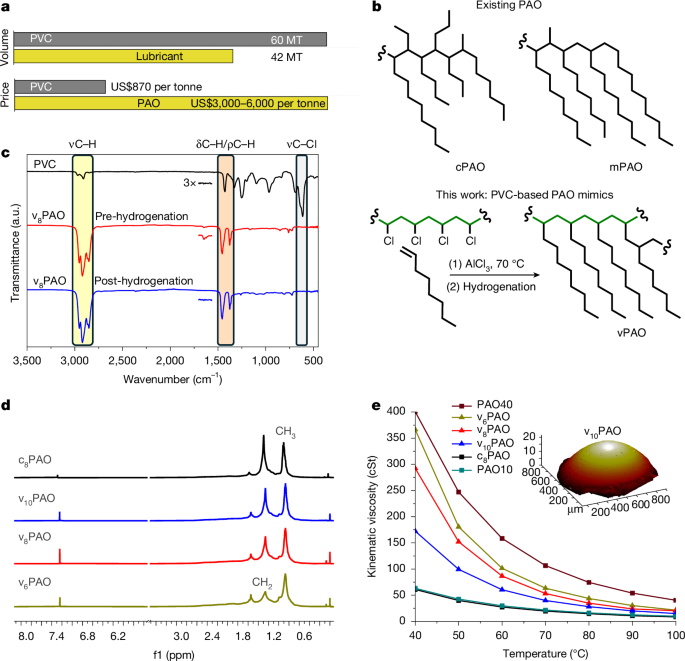
Polyvinyl chloride (PVC) is a thermoplastic used ubiquitously in households and industry owing to its light weight, mechanical strength, durability, low cost and ultraviolet and fire resistance1,2. With a production volume of about 60 million tonnes annually2, post-consumer and post-industrial PVC waste pose marked environmental challenges, such as leaching chlorohydrocarbons and additives, which contaminate groundwater and soil1,2,3,4. To address the formidable challenge of recycling PVC and achieving carbon circularity, valorization into high-value products is essential to mitigate the associated costs and offer high financial incentives for reusing plastic waste5,6,7,8,9,10,11,12,13,14. Here we report a method for upcycling PVC into high-value lubricants with controllable viscosities. Using AlCl3 at a mild temperature of 70 °C, PVC undergoes dechlorination, alkylation and chain scission, producing vinyl-derived polyalphaolefins (vPAO). PVC serves as an effective template for the alkylation of α-olefins of various chain lengths, producing vPAO with limited short branches in the backbone without the need for metallocene catalysts essential to current PAO technology. The PVC-derived lubricants exhibit tunable molar masses, kinematic viscosities at 100 °C (KV100 ≈ 14.9–26.3 centistokes), a low coefficient of friction (COF ≈ 0.08–0.15) and a high viscosity index (VI up to 130). This work highlights an economical approach to using PVC as a low-cost feedstock to synthesize high-value lubricants with superior tribological properties, meeting the demand for sustainability in both the plastic and lubricant industries.
This is a preview of subscription content, access via your institution
Access Nature and 54 other Nature Portfolio journals
Get Nature+, our best-value online-access subscription
Prices may be subject to local taxes which are calculated during checkout
Additional data are provided in the Supplementary Information, and the raw files are available at Dryad (https://doi.org/10.5061/dryad.xgxd254x8).
Kudzin, M. H., Piwowarska, D., Festinger, N. & Chruściel, J. J. Risks associated with the presence of polyvinyl chloride in the environment and methods for its disposal and utilization. Materials 17, 173 (2024).
Article
ADS
CAS
Google Scholar
Statista. Polyvinyl chloride (PVC) production volume worldwide in 2018 and 2025. https://www.statista.com/statistics/720296/global-polyvinyl-chloride-market-size-in-tons/ (2018).