// NATURE NEWS — SPAZIO & SCIENZA
A compendium of next-generation patient-derived models for diverse cancers
Nature
(2026) Cite this article
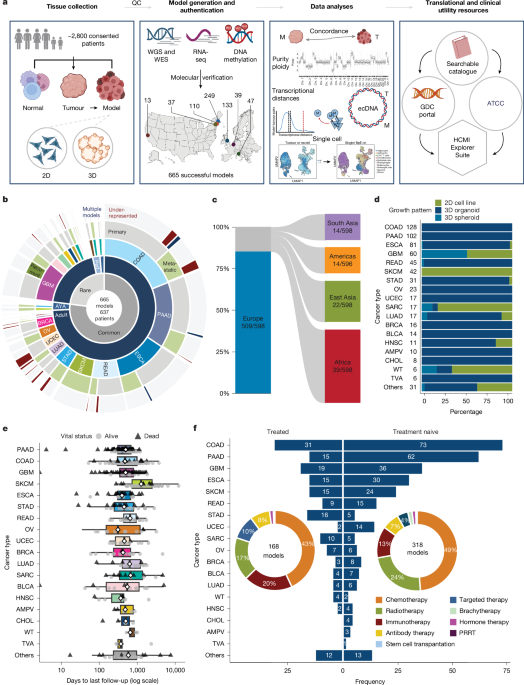
The development of new therapeutics and the validation of pathogenetic cancer mechanisms require representative laboratory models1,2. However, existing collections represent only a fraction of the diversity observed in human cancer2,3,4. Recent technologies have enabled efficient in vitro model derivation (for example, tumour organoids)5. However, whether these maintain essential properties of patient tumours during long-term expansion has not been systematically investigated. Here we present results of a large-scale international programme—the Human Cancer Models Initiative—which involved the generation of a resource of 665 next-generation models from 2,780 donors with 25 cancer types and integrated tumour–model whole genome, exome, methylome and transcriptome analyses. The resource provides 522 models with comprehensive clinical data, 153 models of rare cancers and 71 models from participants with non-European ancestry. Analyses of 421 matched tumour–model pairs reveal high genetic (97.8%) and epigenetic (95%) concordance and define correlates of model discordance. Single-nucleus RNA sequencing of tumour–model pairs reveals subsets of models in which culture conditions significantly influence cell states. Finally, we characterize model preservation of extrachromosomal DNA and post-treatment mutational signatures to provide opportunities to study therapeutic resistance. This model repository is being made available to the community—including multimodal molecular profiling, clinical information and integrative software tools—thus providing a valuable resource for preclinical investigation of cancer pathogenesis and treatment response.
Major international projects have generated cancer atlases3,6 that have revealed many molecular underpinnings of human malignancies7,8,9. Provocative hypotheses about most types of cancer have emerged, with each requiring preclinical validation to support both basic science and drug discovery. Well-characterized cancer models that maintain the fidelity of diverse human tumour types and clinical states are required for such validation10.
Efforts to genomically characterize large cohorts of cancer models have produced comprehensively annotated compendia of over 1,000 cell lines1,2,11,12, which have enabled large-scale mapping of cancer dependencies9,13,14,15,16. However, existing cell lines typically exhibit limited phenotypic complexity, uncertain fidelity to the originating tumour specimen and inadequate clinical information17.
Advances in the technology of cell culture, including biologically informed selection of defined growth factors and new plating methods, have facilitated the development of new patient-derived models5,18,19,20,21,22,23,24,25. However, reports suggest that only a minority of such models could be indefinitely propagated and distributed.
Here we present the generation and comprehensive genomic, transcriptomic and epigenomic characterization of 665 fully accessible patient-derived organoid, neurosphere and cell line models, which were created as part of the international Human Cancer Models Initiative (HCMI). Companion papers26,27 demonstrate the utility of HCMI models for the systematic evaluation of gene essentiality and drug sensitivity.
Between 2016 and 2021, 2,780 patients from the United States, United Kingdom, Italy and the Netherlands consented to participate in the HCMI study (Fig. 1a and Supplementary Table 1). Active attempts were made to include diverse tumour types and patients from under-represented populations (Supplementary Methods, ‘Human subjects protocol’). Tissue samples were transferred to Cancer Model Development Centers at the Broad Institute, Cold Spring Harbor Laboratory, Weill Cornell Medicine, Stanford University, the Hubrecht Institute and the University of Verona ARC-Net Research Centre (Supplementary Table 1) for model generation, with additional models derived and contributed by t