// NATURE NEWS — SPAZIO & SCIENZA
Uncovering the mechanism of female restitution in sugarcane hybrids
Nature
(2026) Cite this article
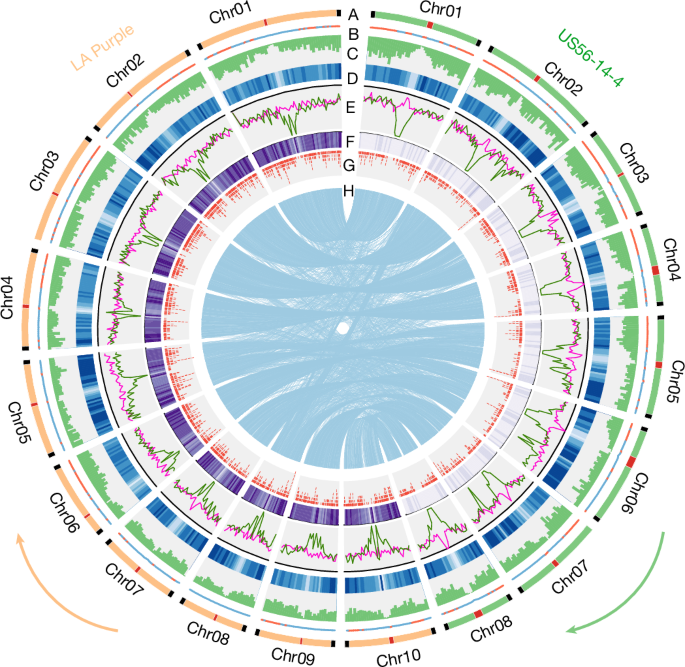
Variations of meiosis, which normally halve genetic complements prior to fertilization, can have profound consequences. For example, whole-genome duplications (polyploidy) have shaped the evolution and diversification of most angiosperm lineages. The century-long success of sugarcane interspecific hybrids has been attributed to unusual female restitution—an unreduced maternal gamete fusing with a normal haploid paternal gamete1,2. Here we generated haplotype-resolved genomes of octoploid Saccharum officinarum LA Purple and decaploid Saccharum spontaneum US56-14-4. Eight F1 hybrids between these species exhibited 2:1 maternal to paternal genomic ratios, with 2 assemblies revealing canonical haploid sets of approximately 40 paternal and approximately 80 maternal chromosomes. The maternal chromosomes comprise 40 pairs of duplicated, partially recombined sister chromatids that retain around 62.5% of maternal genetic diversity, characteristic of second division restitution. Using single-molecule long-read sequencing and a novel algorithm that is broadly applicable to polyploid genomes, we identified two classes of recombination breakpoints, including a previously unrecognized configuration supported by both recombinant and non-recombinant reads, across all hybrids and diagnostic of second division restitution. These findings resolve a century-old cytological debate, add new insights into meiotic variations, and offer a genomic approach to accelerate genetic gain in this globally critical sugar and bioenergy crop.
This is a preview of subscription content, access via your institution
Access Nature and 54 other Nature Portfolio journals
Get Nature+, our best-value online-access subscription
Prices may be subject to local taxes which are calculated during checkout
The genome assemblies and corresponding gene annotation results, raw sequencing datasets of US56-14-4, 10-9201, 10-9208 and the other six F1 hybrids have been deposited at the Genome Sequence Archive (GSA) database71 in the National Genomics Data Center, Beijing Institute of Genomics (BIG), Chinese Academy of Sciences and China National Center for Bioinformation (CNCB), under accession numbers PRJCA032574 (CRA020620 and CRA022922). The LA Purple genome is available from CNCB Genome Warehouse under accession GWHHOJF00000000.1. The raw sequencing fastq data of LA Purple are available from CNCB BioProject accession PRJCA039904.
The code of an algorithm KLASSIFY that classify chimeric reads and identify breakpoints is available on GitHub https://github.com/tanghaibao/klassify (including full simulation and evaluation scripts with exact parameters, random seeds and example commands) and the code is archived on Zenodo at https://doi.org/10.5281/zenodo.20838810 (v0.1.6)72.
Bremer, G. A cytological investigation of some species and species-hybrids of the genus Saccharum. Genetica 5, 273–326 (1923).
Bremer, G. Problems in breeding and cytology of sugar cane. IV. The origin of the increase of chromosome number in species hybrids of Saccharum. Euphytica 10, 325–342 (1961b).