// NATURE NEWS — SPAZIO & SCIENZA
Membranolytic peptide programs immunogenic cell death for cancer therapy
Nature
(2026) Cite this article
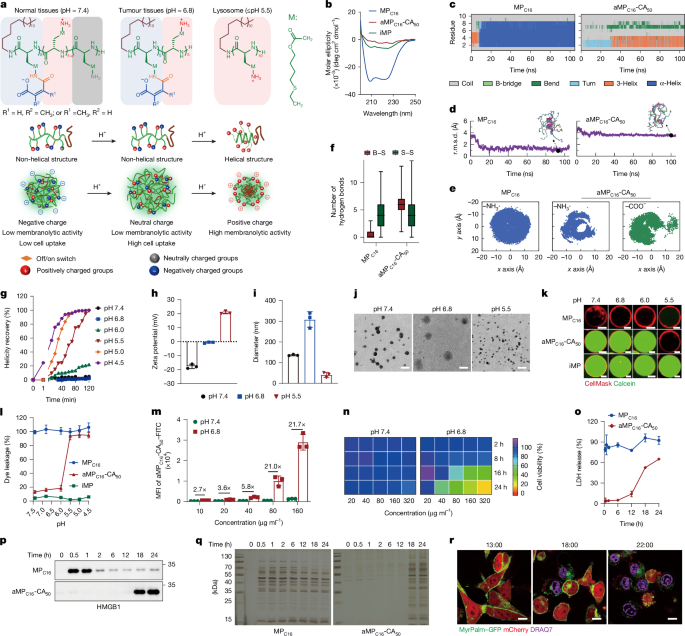
A rational design for facilitating innovative cell death modes can substantially aid advances in antitumour therapy1,2. Here we design and implement a unique mode of immunogenic membranolytic cell death (mLCD) in tumour cells, characterized by time-lagged rupture from the lysosomal to plasma membranes; this approach was found to robustly potentiate immune checkpoint blockade therapy. This mode of mLCD was induced by the synthetic-acid-responsive membranolytic peptide (aMP) aMPC16-CA50, which exhibits hierarchical responsiveness to the decreasing pH associated with the tumour extracellular environment and lysosomes. aMPC16-CA50 activated an inflammatory transcriptional program in tumour cells, potentiating their ability to induce antigen presentation on class I major histocompatibility complex molecules on dendritic cells and the subsequent activation of T cells. The pH-responsive kinetics and membranolytic activity of the membranolytic peptides had a critical role in enhancing the immunogenicity of lytic tumour cells through the spatiotemporal regulation of the membrane-rupture processes. Furthermore, aMPC16-CA50 exhibited a considerable advantage in enhancing the antitumour efficacy of immune checkpoint blockade therapy through the promotion of antitumour immune response. Moreover, its systemic administration was well tolerated in mice. Overall, we successfully programmed a unique mode of immunogenic mLCD in tumour cells through the spatiotemporal regulation of membrane-rupture processes using a synthetic pH-responsive membranolytic peptide amenable to manipulation.
This is a preview of subscription content, access via your institution
Access Nature and 54 other Nature Portfolio journals
Get Nature+, our best-value online-access subscription
Prices may be subject to local taxes which are calculated during checkout
RNA-seq and scRNA-seq data generated in this study have been deposited in the NCBI Sequence Read Archive under the BioProject accession numbers PRJNA1091224, PRJNA1413508 and PRJNA1417626. Publicly available resources used for analysis include GRCm38 mouse genome assembly (https://www.ncbi.nlm.nih.gov/datasets/genome/GCF_000001635.26/), MSigDB for Hallmark, GO and Reactome gene sets (https://www.gsea-msigdb.org/gsea/msigdb/mouse/genesets.jsp) and the DAVID web server for functional annotation (https://david.ncifcrf.gov). Source data are provided with this paper.
Conrad, M. et al. Cell death in cancer. Cell 189, 2322–2356 (2026).
Article
CAS
PubMed
Google Scholar
Mao, C., Jiang, D., Koong, A. C. & Gan, B. Exploiting metabolic cell death for cancer therapy. Nat. Rev. Cancer 26, 27–45 (2026).