// NATURE NEWS — SPAZIO & SCIENZA
Vacuum birefringence and the polarized X-ray emission from a radio magnetar
Nature
(2026) Cite this article
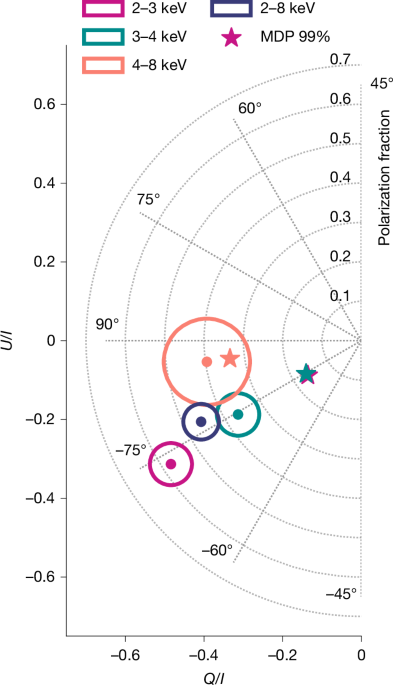
Magnetars are isolated neutron stars with exceptionally strong surface fields exceeding 1014 G (ref. 1). Their bright X-ray emission probes physical regimes in which quantum electrodynamics (QED) influences radiation propagation2,3,4. Strong magnetic fields induce polarization-dependent refractive indices in the vacuum5,6; such vacuum birefringence remains a long-standing but unconfirmed prediction of QED. Here we report phase- and energy-resolved polarization measurements of the radio-emitting magnetar 1E 1547.0−5408 obtained by coordinating X-ray and radio observations from the Imaging X-ray Polarimetry Explorer, the Neutron Star Interior Composition Explorer and the Parkes/Murriyang Observatory. We detect large polarization degrees (PDs) in the thermally dominant soft X-ray band, reaching phase-averaged values of 65% at 2 keV before substantially decreasing between 2 keV and 4 keV. At certain rotational phases, the 2–3 keV PD rises to nearly 80% while remaining high (≳40%) throughout the radio beam crossing. The phase-dependent X-ray and radio polarization angles are both consistent with the rotating vector model, suggesting that the emission geometries track the large-scale magnetic field of the star. Collectively, these characteristics challenge standard surface emission models using non-refractive propagation of light to infinity. Vacuum-birefringence-governed magnetospheric propagation can naturally explain the X-ray polarization signals. Our results represent a marked advance in probing this hallmark prediction of QED, opening a new cosmic window into superstrong-field quantum physics, thereby motivating further observational and theoretical studies concentrating on this domain.
This is a preview of subscription content, access via your institution
Access Nature and 54 other Nature Portfolio journals
Get Nature+, our best-value online-access subscription
Prices may be subject to local taxes which are calculated during checkout
NICER observations (ObsIDs: 8020300101, 8020300102, 8020300103 and 8020300104) and IXPE observations (04003801) are readily accessible in the HEASARC data archive: https://heasarc.gsfc.nasa.gov/W3Browse (https://doi.org/10.25504/FAIRsharing.979d22). Radio observations made by Murriyang/Parkes (ObsIDs: r070819_124237, uwl_250326_173709, uwl_250330_171906 and uwl_250331_131207; doi10.4225/08/52292AE9B2D80, doi10.25919/rzdr-pw25 and doi10.25919/v5hn-4v34) are publicly available from the CSIRO Data Access Portal (https://data.csiro.au/) following an 18-month proprietary period starting on the observation date.
Data reduction and analysis of X-ray products were performed using publicly available software HEAsoft v.6.35.0 (https://heasarc.gsfc.nasa.gov/docs/software/lheasoft/) from the High Energy Astrophysics Science Archive Research Center (HEASARC), particularly FTOOLs v.6.35.1, SAOImage DS9 v.8.4b1 and Xspec v.12.15.0. Generation and calibration of the NICER event lists was also performed by NICERDAS v.12 of HEASoft. The simulation and analysis framework ixpeobssim v.31.1.0 was used to generate high-level IXPE data products (https://ixpeobssim.readthedocs.io/en/latest/). Moreover, the software filterbackground.py was used for the treatment of the IXPE background, found at GitHub (https://github.com/aledimarco/IXPE-background). Timing analysis was performed using tempo2 (https://github.com/mattpitkin/tempo2), PINT (https://github.com/nanograv/PINT) and CRIMP (https://github.com/georgeyounes/CRIMP/tree/main). PyXspecCorner (https://github.com/garciafederico/pyXspecCorner) and corner.py (https://corner.readthedocs.io/en/latest/) were used to generate the X-ray spectro-polarimetric and radio RVM corner plots, respectively. Additional custom code for generating figures and performing analysis is available at GitHub (https://github.com/rae-stewart/Polarimetric-Analysis-of-1E-1547.0-5408). Custom code for the MAGTHOMSCATT Monte Carlo simu