// TOM'S HARDWARE US — HARDWARE & GADGET
How optical interconnects and silicon photonics emerged as AI's next hot commodity — looming US-China summit puts photonics into the crosshairs
The U.S. remains China's biggest photonics customer
When you purchase through links on our site, we may earn an affiliate commission. Here’s how it works.
The race to solve AI's copper bottleneck for scale-up and scale-out intensified last week, as the Federal Communications Commission (FCC) is drafting a measure that would block imports of new Chinese transceiver models, with officials hoping to publish the rule before the end of 2026. Yesterday, we covered exactly how much of the Secure Networks Act might rely on Chinese-made optical module manufacturers.
The technology is currently driving billions in acquisitions among companies like Marvell and Nvidia, and sending stock prices for dedicated Western Photonics companies like Coherent and Lumentum skyrocketing, amid calls that key materials like indium phosphide are in short supply.
Following the FCC's Secure Networks Act proposal, the market reacted immediately, with shares of China’s Zhongji Innolight, Eoptolink, and TFC Optical tumbling in early Shenzhen trading. Meanwhile, U.S. rivals Coherent and Lumentum closed 12.4% and 8.9% higher. Before Wednesday ended, however, the Chinese companies had clawed back much of the ground, even as analysts downplayed the impact of such a ban. Innolight still finished 7.3% lower in Shenzhen, while TFC actually closed 2.3% higher.
The whipsawing market movement was an apt representation of the potential implications of such a ban. Photonics, the industry's answer to its latest bottleneck of moving data between chips, is arguably the hottest technology in AI infrastructure right now. It is also a market defined by deep mutual entanglement. However, the FCC's proposal conveniently overlooks the fact that the biggest customer of China's photonics hardware is the United States.
With a crucial U.S.-China summit looming in September, the AI supply chain is being weaponized, once again, for global trade and supply negotiations, turning Silicon Photonics into a bargaining chip.
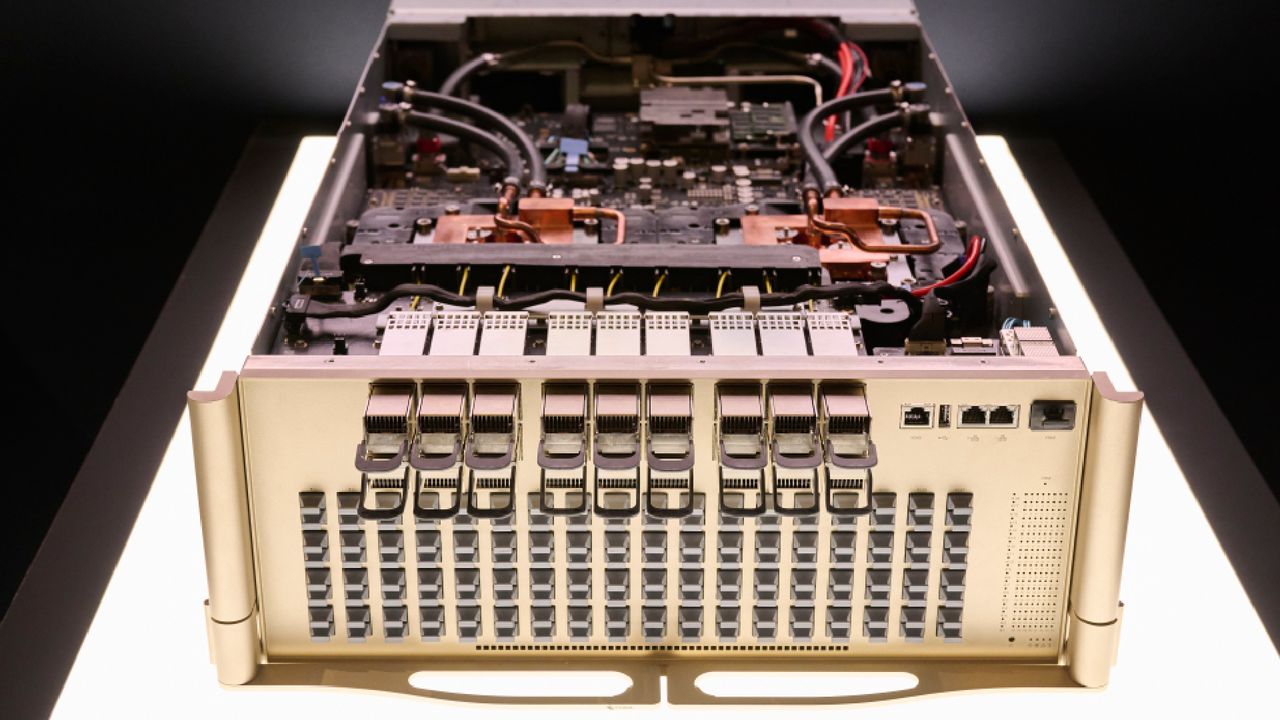
As AI clusters scale into the hundreds of thousands of processors, the biggest problem is moving data between them. Computing tasks on frontier AI models are distributed across thousands of GPUs using parallel computing techniques. This setup requires the processors to exchange huge volumes of data multiple times a second. Copper interconnects still dominate, but as per-lane signaling climbs toward 200 Gbps, attenuation and crosstalk make passive copper impractical beyond a meter or two. Optical transceivers solve that problem by converting a chip's electrical signals into photons for transmission over fiber and back again, carrying far more data over longer distances at lower power.
As we examined in our recent detailed AI photonics roadmap, Vendors are racing from 800G modules to 1.6T parts while shortening electrical paths with co-packaged optics, which moves optical engines even closer to switch ASICs and, eventually, accelerators. The race to solve AI's photonics bottleneck is therefore becoming as strategically important as securing GPUs and HBM.
The money is already moving accordingly. Nvidia has reportedly committed $4 billion across Coherent and Lumentum to lock up supply. Elsewhere, Marvell agreed to pay $3.25 billion upfront for silicon photonics startup Celestial AI, with earnouts potentially taking the deal to $5.5 billion. At the same time, Elon Musk has received FTC clearance to acquire Mesh Optical. Meanwhile, Microsoft, Meta, and OpenAI have teamed with Broadcom, AMD, and Nvidia in an optical interconnect alliance to develop an open optical scale-up interconnect.