// ARS TECHNICA — INTELLIGENZA ARTIFICIALE
Google reveals 2026 hardware lineup: Pixel 11, Pixel Watch 5, and Pixel Tag
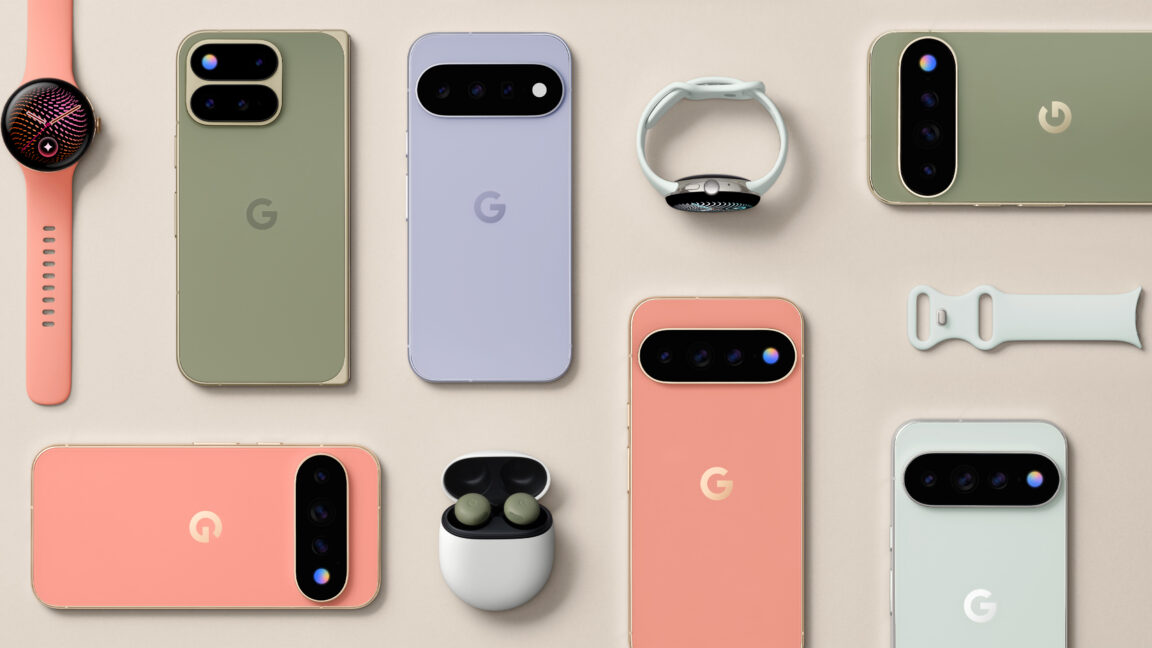
Google focuses more on AI and curated experiences than spec upgrades in 2026.
Google has revealed its Pixel phone hardware for 2026, and you won’t be surprised. The Pixel 11 series looks a lot like last year’s lineup, featuring an evolution of the design Google adopted with the Pixel 9. There are some minor tweaks, a few new hardware goodies, and yes, even more Gemini-powered AI. The new phones are joined by an updated Pixel Watch 5 with much the same story, as well as Google’s first in-house tracker device, the Pixel Tag. And you can place orders for all of Google’s new hardware today.
The Pixel 11 series is clearly the star of the show. You might even call it the highlight—or HiLight. Just as the leaks predicted, Google’s most notable hardware innovation for the 2026 Pixel phones is the return of the notification LED (sort of).
The new HiLight feature is available on the Pro phones, so the base model Pixel will remain unilluminated. HiLight consists of a ring of RGB LEDs inside the flash assembly on the back of the phone. It lights up when you’re talking to Gemini, so you don’t have to look at the screen of your phone to know you’ve been heard or that the AI is working. Thus, it makes the most sense when the phone is lying face down.
The multicolored LEDs can also alert you to an incoming call from specific contacts. This works for both standard phone calls and voice calls in WhatsApp. But it’s only those apps. It sounds like you can’t use HiLight for any other kind of notification for other apps—not even for a text in Google Messages. Notification LEDs can be useful, but the ones we had years back were infinitely more configurable. HiLight is locked down in modern Google fashion, and I wouldn’t be surprised if we see more HiLight features drip-fed in future Pixel Drops.
You may also notice the camera bars are a bit different this year. Google is keeping this distinctive design element, but the bar has shrunk considerably on the base model. The Pixel 11’s bar now rises just a couple of millimeters above the back of the phone, making it a bit less awkward to drop in your pocket. All the bars now have edge-to-edge glass, losing the metal inlay that previously housed the flash and thermometer. The latter, unsurprisingly, is gone this year.
The displays on this year’s Pixel phones are brighter. While the base model remains at 3,000 nits, the Pro phones have all risen to 3,600 nits. Google also says the phones use new glass that is twice as resistant to scratching.
It’s not all upgrades, though. For the past few years, Google’s battery capacity has been inching upward, but the Pixel 11 series bizarrely reverses that trend. The three flat phones all have slightly lower capacity. It’s not a huge difference—under 100 mAh for each—but that’s still moving in the wrong direction when one of the primary complaints about Pixel phones is the middling battery life. The Pixel 11 Pro Fold is even stranger, dropping a full 200 mAh of capacity to land at 4,806 mAh. However, it is a little lighter and thinner.
For what it’s worth, Google is claiming the same “24+ hours” of total battery life on the new phones. There is at least a new “Extreme Charging Mode” that keeps charging wattage higher for longer. This generates more heat, but the chipset will slow down to compensate so you don’t overheat.
Google probably figured it could get away with smaller batteries because the new Tensor G6 uses less juice. The company claims a 20 percent boost in power efficiency, along with 25 percent faster browsing and 15 percent faster app loading. But this is all Google is saying about Tensor G6—there are no official chip specs. Based on leaks, Tensor G6 is most likely a custom seven-core Arm chip, which has one fewer CPU core than the Tensor G5 had.