// NATURE NEWS — SPAZIO & SCIENZA
Agentic profiles for effective AI governance
Nature
volume 656, pages 320–328 (2026) Cite this article
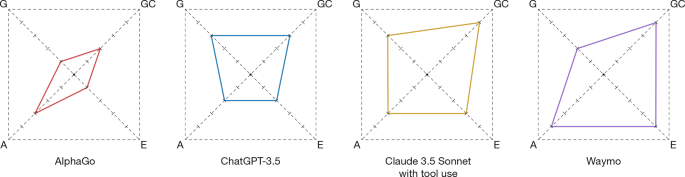
The creation of effective governance mechanisms for artificial intelligence (AI) agents requires a deeper understanding of their core properties and the implications they have for deployment. This paper provides a characterization of AI agents that focuses on four dimensions: autonomy, efficacy, goal complexity and generality. We propose different gradations for each dimension and argue that each dimension raises unique questions about the design, operation and governance of these systems. Moreover, we draw on this framework to construct ‘agentic profiles’ for different kinds of AI agent. These profiles help to illuminate cross-cutting technical and non-technical governance challenges posed by different classes of AI agents, ranging from narrow task-specific assistants to highly autonomous general-purpose systems. By mapping out key axes of variation and continuity across four dimensions, agentic profiles provide developers, policymakers and members of the public with guidance for effective AI governance.
This is a preview of subscription content, access via your institution
Access Nature and 54 other Nature Portfolio journals
Get Nature+, our best-value online-access subscription
Prices may be subject to local taxes which are calculated during checkout
Feigenbaum, E. A. The art of artificial intelligence: themes and case studies of knowledge engineering. In Proc. 5th International Joint Conference on Artificial Intelligence (IJCAI ’77) Vol. 2, 1014–1029 (Morgan Kaufmann, 1977).
Russell, S. J. & Norvig, P. Artificial Intelligence: A Modern Approach (Prentice Hall, 1995).
Sutton, R. S. & Barto, A. Reinforcement Learning: An Introduction (MIT Press, 1998).
Wooldridge, M. in Multiagent Systems: A Modern Approach to Distributed Artificial Intelligence (ed. Weiss, G.) 27–79 (MIT Press, 1999).