// NATURE NEWS — SPAZIO & SCIENZA
Procognitive restoration of PV neuron plasticity in neurodevelopmental disorders
Nature
(2026) Cite this article
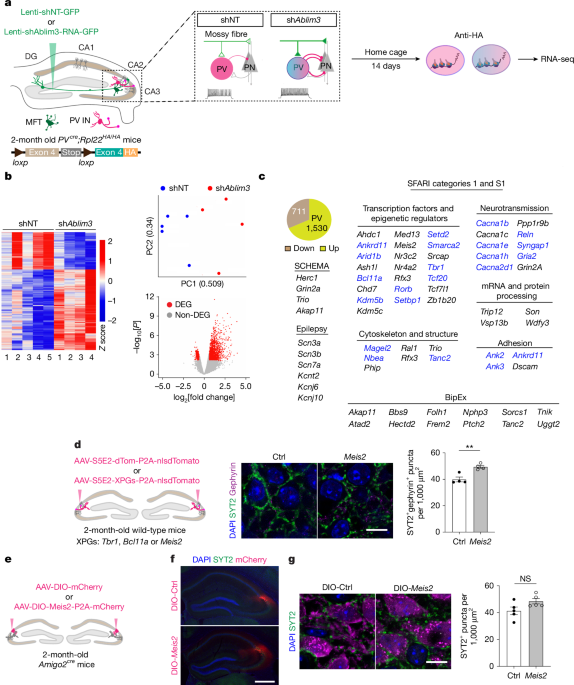
The hippocampus forms memories of our experiences in populations of coactive pyramidal neurons (PNs)1,2,3. Fast-spiking parvalbumin-expressing inhibitory neurons (PV INs) in the dentate gyrus–CA3/CA2 circuit of the hippocampus precisely control PN activity through mossy fibre-dependent feedforward inhibition4,5,6,7,8,9,10,11. PV INs coordinate experience-dependent changes in their intrinsic excitability, synaptic connectivity, physiology and plasticity properties9,12,13,14,15—referred to here as experience-dependent PV IN plasticity—to regulate PN activity. PV IN impairments in early life, when neural circuitry is highly sensitive to experience, are thought to result in network hyperexcitability, seizures and impaired cognition, which are hallmarks of neurodevelopmental disorders (NDDs)16,17,18. Here we designed an input-specific translatome screen to identify regulators of experience-dependent PV IN plasticity genes (XPGs) in the CA3/CA2 subregion of adult hippocampus. We demonstrate that a substantial proportion of upregulated candidate XPGs exhibit haploinsufficiency in autism spectrum disorder, epilepsies, bipolar disorder and schizophrenia, which suggests that there is impaired experience-dependent PV IN plasticity in NDDs. In proof-of-concept experiments, targeted upregulation of a candidate XPG, the homeobox gene Meis2 (ref. 19), in CA3/CA2 PV INs in an NDD risk mouse model in adulthood is sufficient to restore experience-dependent PV IN plasticity. Moreover, ensemble and sharp-wave ripple properties and cognition were improved, and seizures were suppressed. Thus, experience-dependent PV IN plasticity is a convergent mechanism for NDD risk genes that can be re-instated in adulthood to reverse developmental deficits in circuitry, network excitability and cognition.
The hippocampus has a crucial role in memory formation, storage and retrieval to facilitate the experience-dependent calibration of motivated and defensive behaviours2. During the early postnatal period, experience refines the hippocampal circuitry to influence cognitive trajectory20. Disruptions in hippocampal circuitry result in maladaptive neural circuit functions, cognitive impairments and seizures that characterize different NDDs, including autism spectrum disorder (ASD). The identification of ultrahigh-confidence genetic risk factors for NDDs underscores the need to instantiate how experience and genetic risk interact to impair experience-dependent mechanisms that support hippocampal-dependent cognition.
PV INs in the dentate gyrus (DG)–CA3/CA2 circuit of the hippocampus influence encoding, storage, retrieval and routing of memories through activity-dependent regulation of CA3/CA2 PN perisomatic inhibition4,5,6,7,9,10,11. Feedforward inhibition of CA3/CA2 PNs mediated by PV INs dictates their spiking, synchronization of PN activity to form ensembles and the generation of network oscillations to regulate intrahippocampal and inter-regional communication in hippocampal–cortical–subcortical networks11,21,22. To exert these effects on circuitry and network properties, PV INs cell-autonomously coordinate experience-dependent changes in their intrinsic properties, structural reorganization of axonal arborizations and perisomatic synapses in CA3/CA2, regulation of feedforward inhibition of CA3/CA2 and synaptic plasticity9,10,12,13,14,15. Here, these properties are collectively referred to as experience-dependent PV IN plasticity. Loss of PV IN functions in NDDs, including ASD, bipolar disorder, schizophrenia and epilepsies, may arise from genetic risk factors that impair experience-dependent refinement of inhibition mediated by PV INs during the early postnatal period16,17,18,23,24.
Transcription factors and epigenetic regulators co-ordinate changes in gene expression that underlie synaptic physiology, synaptic and structural plasticity and input–output connectivity to mediate experience-dependent