// NATURE NEWS — SPAZIO & SCIENZA
Species intraspecific variation drives tropical forest drought resistance
Nature
(2026) Cite this article
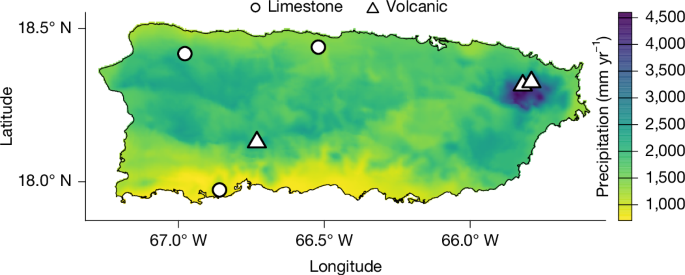
Severe droughts are increasingly driving tree mortality, yet predicting forest resilience remains limited by a lack of understanding of within-species variation in drought resistance1,2,3,4. Although hydraulic traits such as embolism resistance are central to drought survival, studies conducted primarily in temperate regions have reported little intraspecific variation5,6,7,8,9,10,11,12, implying that there are evolutionary constraints in the adaptive potential of tree species. Here we test this assumption using a dataset comprising 11 hydraulic traits for 290 trees representing 18 species collected along Puerto Rico’s fourfold rainfall gradient (1,000 to 4,000 mm per year). We find that substantial intraspecific variation, together with species turnover, drives coordinated shifts in drought resistance across the gradient. Most species exhibit substantially more embolism resistance and wider stomatal safety margins in drier forests, demonstrating a considerable level of intraspecific variation in tropical trees and a mechanism for adaptation to increasingly dry conditions. Species lacking such trait variability may be highly vulnerable under a future drier climate. Incorporating both interspecific and intraspecific trait variation into predictive models will advance our ability to forecast forest resilience to intensifying droughts.
This is a preview of subscription content, access via your institution
Access Nature and 54 other Nature Portfolio journals
Get Nature+, our best-value online-access subscription
Prices may be subject to local taxes which are calculated during checkout
All data have been deposited to the Dryad digital repository70 (https://doi.org/10.5061/dryad.r4xgxd2vb).
All R code has been deposited to the Dryad digital repository70 (https://doi.org/10.5061/dryad.r4xgxd2vb).
Aleixo, I. et al. Amazonian rainforest tree mortality driven by climate and functional traits. Nat. Clim. Change 9, 384–388 (2019).
Article
ADS
Google Scholar