// KOTAKU — GAMING
I Think Kingdom Hearts Is Going To Change The World
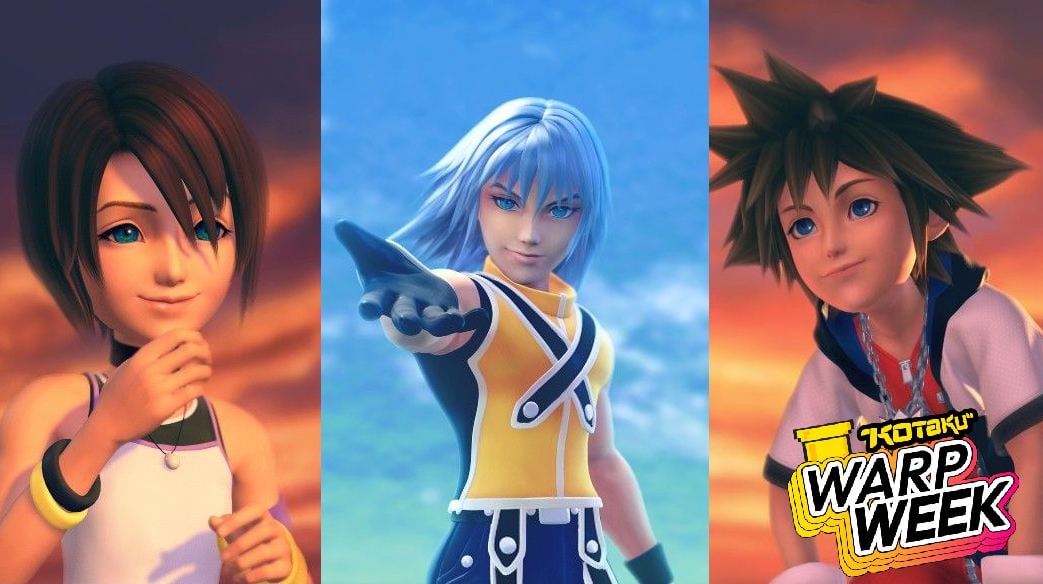
Kingdom Hearts has thrown open a door that we’re going to have a hard time closing. I just feel it. As silly as it sounds, it worries me. Yes, the game about a boy with impossibly large shoes going on adventures through Disney worlds with Donald Duck and Goofy in tow rankles some part of my brain. The unforeseen success of melding Final Fantasy aesthetics and mechanics with the properties of several bonafide hits from the House of Mouse like The Little Mermaid is a surprisingly uncomfortable prospect.
In case you’ve been under a rock, a new phenomenon has seized the world; its name is Kingdom Hearts. This baffling new RPG from Square Soft is helmed by Tetsuya Nomura, mostly recognized for his character designs in games like last year’s acclaimed Final Fantasy X. Despite the implications of that lineage, Kingdom Hearts happily eschews tradition, confecting a hybrid of turn-based combat and real-time action that is as bold as it is awkward.
In Kingdom Hearts, you play as a child known as Sora who swings around a Keyblade—it is exactly what it sounds like—and does battle against the forces of darkness, namely an army of impish figures known as Heartless. As he does so, he travels through multiple worlds ripped from the imaginations of Disney’s animators, traveling from the jungles of Tarzan to the backstreets of Aladdin‘s Agrabah, all the while befriending the world’s respective heroes and pummeling their ne’er-do-wells.
So why does this children’s game about the power of friendship concern me? The game that has quickly garnered so much Game of the Year buzz? What could possibly offend about the tale of a boy who dreams of adventure beyond his home, rids worlds of their darkness, and saves his friends along the way?
Nothing, really. At least, not on its face. I’ve got no ill will toward Kingdom Hearts, a game that is about as pleasant as a frolic through an actual Disney park. I mean, I wish its platforming was anywhere near the level of Super Mario Sunshine, but it’s still a delight in most other regards. But by its very nature, there’s something quietly uncomfortable about Kingdom Hearts that it feels like we’re all missing. A disarming quality that the game kind of dangles in its players’ faces.
I resent the brand synergy of it all. The ease with which the amalgamation that is Kingdom Hearts takes shape. And listen, I’m not immune to the joy of a crossover. Hell, I was thrilled by the “Forever Red” episode of Power Rangers Wild Force that paid homage to and featured Red Rangers of the series’ past all in one place. Seeing the heroes of my favorite Saturday morning show come together to combat one big evil has a way of warming my heart and producing a grin a mile wide. But there feels like a significant difference between the effect of a “Forever Red” and the kind of thing that Kingdom Hearts seems to be paving the way for.
I loved banging together the disparate action figures of my youth as much as the next person. My Spider-Man figure is very accustomed to doing battle with the Teenage Mutant Ninja Turtles. But that played out on the battleground of my mind. It wasn’t packaged and sold back to me. It isn’t a product filled to the brim with big corporate-owned symbols, seemingly for the sake of playing to my nostalgia and my love of properties more than my love of the stories, characters, and themes that made those properties resonate in the first place.
Kingdom Hearts bridges the divide between mediums with such aplomb that I’m sure it inspires envy in developers around the world. Licensed games are dreaded affairs—a necessary discomfort for many developers to keep the lights on—but here’s one that has managed to shed much of that baggage. And while it’s great to see a title like this overcome those odds and to know that the work of the developers at Square is being celebrated on the grand stage, I can’t help but wonder at what cost when I look at Kingdom Hearts, an endearing game that is sometimes quite a mess.
To be