// ITS FOSS — LINUX & OPEN SOURCE
Overshared to an AI? Proton's Tool Will Give You a Reality Check
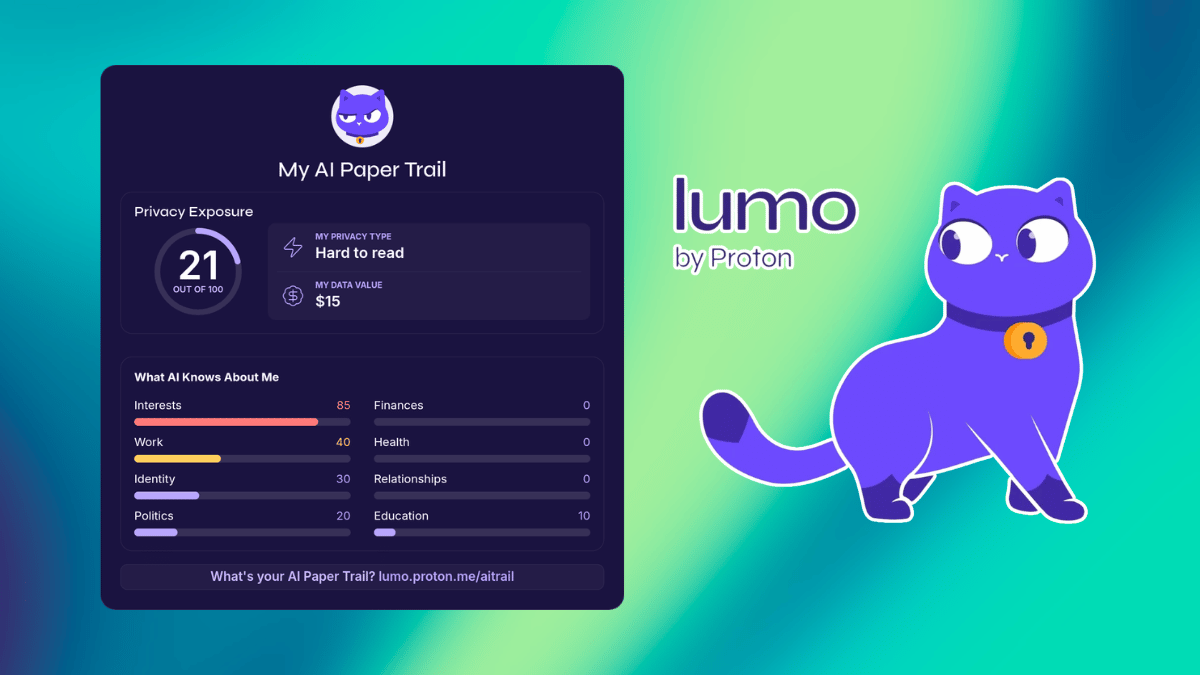
Proton has launched AI Paper Trail, a free tool that shows people what their AI chatbot conversations reveal about them. It runs on Lumo (partner link), the company's privacy-focused AI assistant, and works by digging through exported ChatGPT or Claude conversation history.
Once you upload your content, the tool starts building a personal report around four categories. There's a "Privacy Type," a personality label based on how someone approaches their own data. Then comes an "AI Exposure Score," a number built from how many personal data points got pulled out of the conversations and how revealing they are.
The report also breaks down what the AI actually knows about you, covering identity, habits, relationships, and interests. On top of that, it puts a monetary figure on what this information could be worth to an AI provider.
And none of the uploaded data sticks around on Proton's server; the company says that it gets deleted right after analysis, and the resulting report stays visible only to the person who generated it.
The reasoning behind AI Paper Trail comes down to how casually people treat individual AI prompts. A single question about travel plans or a work email draft might seem harmless on its own.
But stack up months or years of conversations covering someone's job, relationships, health concerns, and finances, and a surprisingly complete picture starts to form.
Eamonn Maguire, Director of Engineering at Proton, notes that:
What they have done here is hit two targets with one shot, offering people a privacy-focused tool that pushes them toward more conscious decisions when interacting with AI chatbots, while steering them straight into Lumo in the process.
This is a superb way to market a chatbot that focuses on privacy instead of mining every inch of your soul, erm, personal data.
I wanted to see for myself how the tool worked, so I first ChatGPT some information about how I approach certain subjects, saved it into memory, and then got back into Proton's AI Paper Trail to see what it could make of it.