// ITS FOSS — LINUX & OPEN SOURCE
Book Review: The Ultimate AI Guide for Linux Engineers
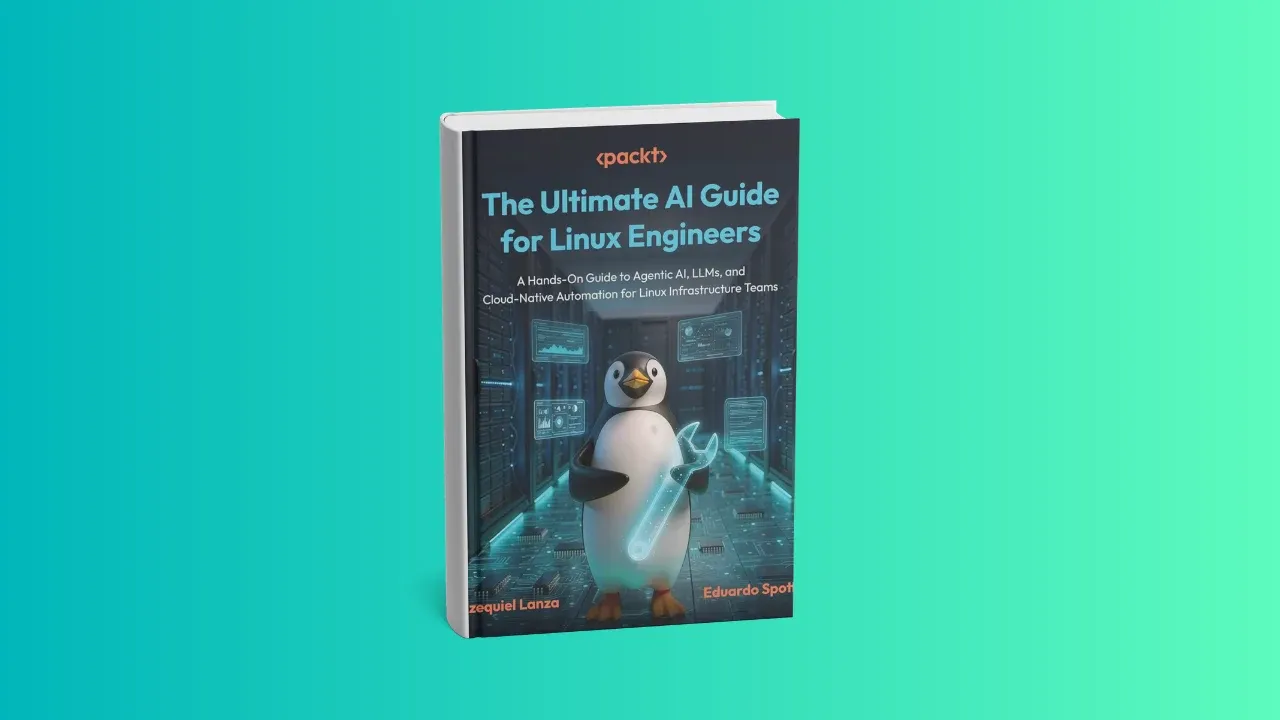
Even Linus Torvalds is fine with AI being used in Linux kernel development these days, and it's everywhere else in the Linux and tech world too. The time has come to stop ignoring AI and start using it as a tool and to use it well, especially if you are a professional sysadmin or DevOps.
That's why seasoned Linux professionals, Ezequiel Lanza and Eduardo Spotti wrote the book The Ultimate AI Guide for Linux Engineers that I am reviewing here. The book is published by Packt and you can find it on Packt, O'Reilly and Amazon.
Note that the book is written for people who already know and use Linux professionally. That means sysadmins, devops, SREs, system engineers, network engineers. The book collectively calls them "Linux engineers" and I like that term.
Basically, it is for the people who are more used to doing things the old way and unsure where and how to fit AI into their regular workflow.
The book opens with "Linux engineers have always been expected to do more with less," and that's the core idea of the book: using AI effectively to improve efficienncy.
The examples are good, and if you've managed servers and infrastructure before, you'll relate to them. That's what makes the book interesting: it's written from a sysadmin/DevOps perspective.
To reduce the risk of letting AI agents loose on your systems, the authors suggest best practices like role-based access, limiting operations to read-only wherever possible, and logging all AI actions for auditing.
There are also examples and sample code you can adapt for your own workflow with some modification, like an anomaly detector you could plug into your Linux observability stack.
Although the book has 12 chapters and runs over 300 pages, I find that the book is divided into four core sectors:
The book starts by explaining AI, machine learning (ML), and large language models (LLMs) specifically in Linux contexts, covering the practical differences between training, fine-tuning, and inference.