// NATURE NEWS — SPAZIO & SCIENZA
Psychedelics tune the brain to the environment
Stefan Borgwardt is in the Department of Psychiatry and Psychotherapy, University of Lübeck, Lübeck D-23538, Germany.
Search author on:
PubMed
Google Scholar
Mihai Avram is in the Department of Psychiatry and Psychotherapy, University of Lübeck, Lübeck D-23538, Germany.
Search author on:
PubMed
Google Scholar
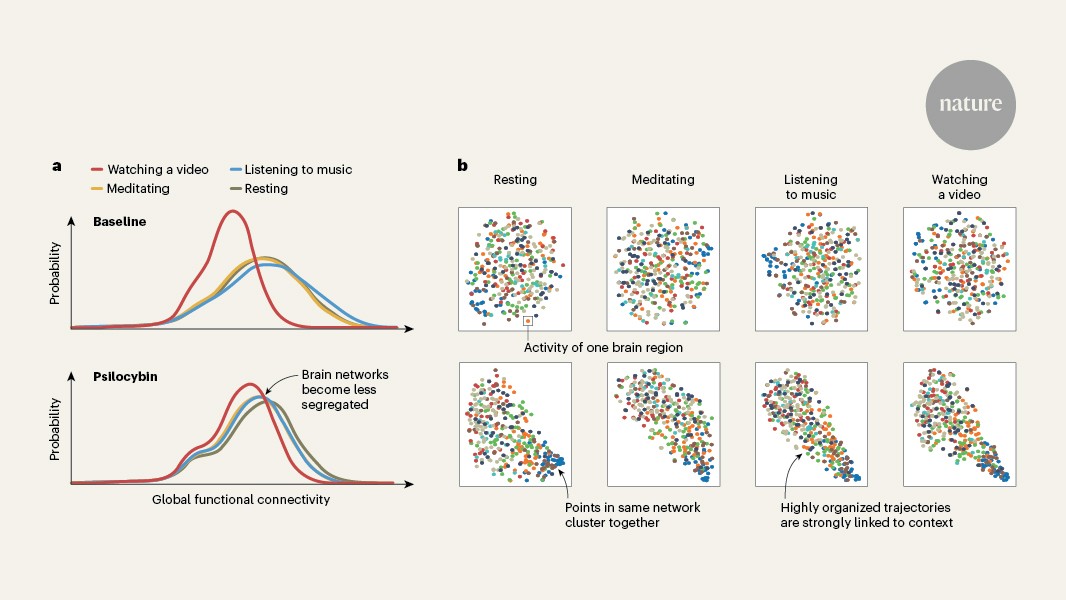
Classic psychedelic compounds — a group that includes psilocybin, LSD, DMT and mescaline — induce profound alterations in perception, cognition and emotion. These substances have captured scientific and clinical attention, partly because guided treatment with psychedelics can provide rapid and long-lasting relief for people with certain psychiatric conditions, such as major depressive disorder1. However, despite the promise that psychedelics show in the clinic, the neural mechanisms that link their acute effects to lasting therapeutic benefits are poorly understood. Human neuroimaging studies have consistently shown that psychedelics disrupt the brain’s intrinsic functional organization, producing a ‘desynchronized’ state2. Writing in Nature, Stoliker et al.3 provide a compelling new perspective: rather than simply making brain activity noisier, psilocybin reorganizes neural dynamics in relation to a person’s surrounding world.
Access Nature and 54 other Nature Portfolio journals
Get Nature+, our best-value online-access subscription
Prices may be subject to local taxes which are calculated during checkout
Goodwin, G. M. et al. N. Engl. J. Med. 387, 1637–1648 (2022).
Article
PubMed
Google Scholar