// HACKER NEWS — CYBERSECURITY
How We Made a Text-to-Speech Model Respond in Sub-50 ms
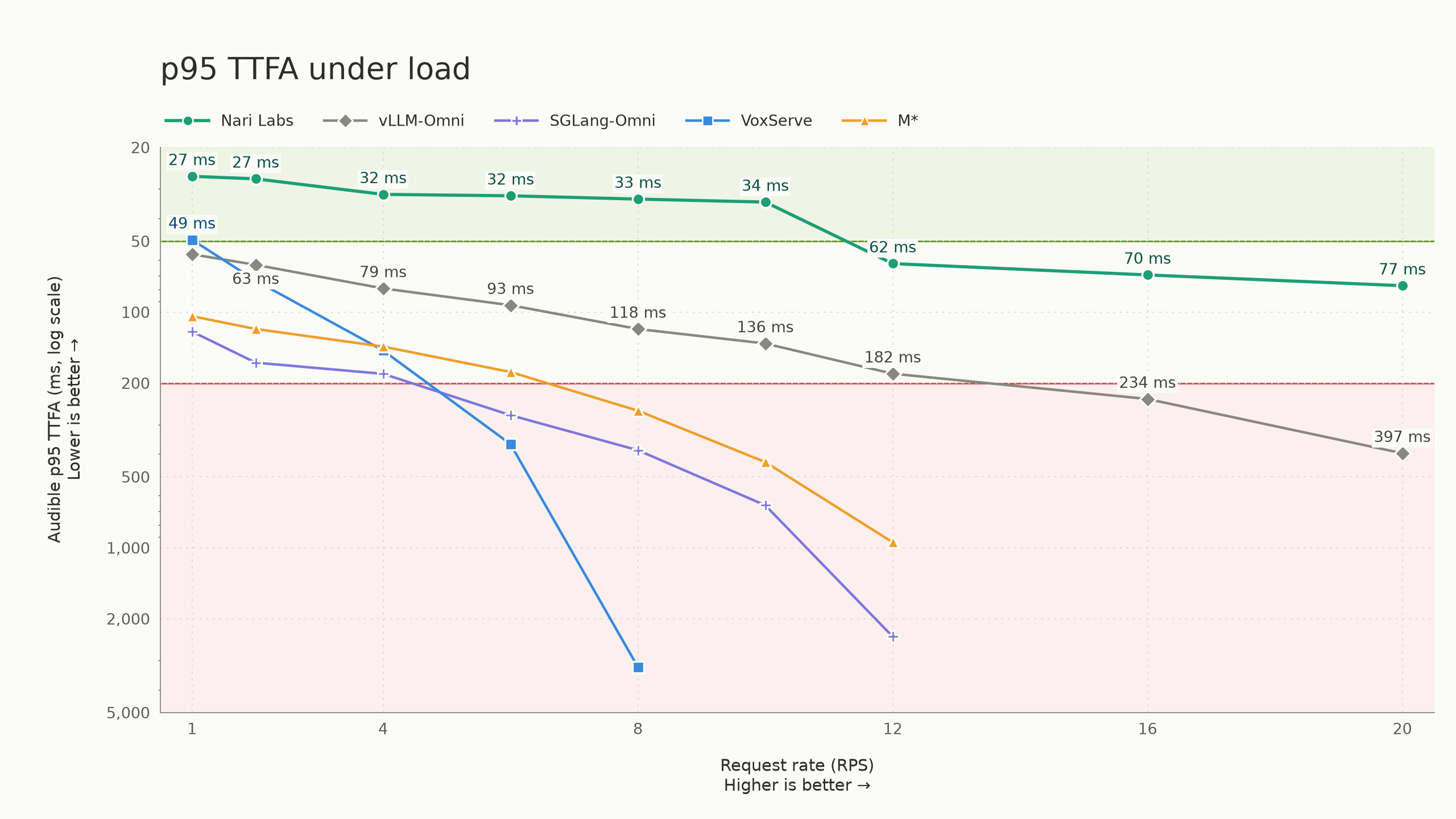
Our Qwen3-TTS 1.7B CustomVoice implementation achieves 10 requests per second (RPS) and sub-50 ms p95 time-to-first-audio (TTFA) while maintaining real-time playback on a single NVIDIA H100 SXM.
We compare five implementations: ours, vLLM-Omni, SGLang-Omni△, VoxServe, and M*, under Poisson open-loop traffic. After tuning each implementation for low-latency streaming, ours is the only one to achieve sub-50 ms p95 TTFA. We maintain sub-50 ms p95 TTFA through 10 RPS and keep it below 100 ms even at 20 RPS.
Our system produces approximately 630 characters per second at 10 RPS. At $4.29 per hour for a 1× H100 SXM instance, this translates to ~$2 per 1M characters at full utilization1. For comparison, ElevenLabs V3 is $100 / 1M and Cartesia Sonic 3.5 is $49 / 1M at a higher TTFA.
We open source the implementation and benchmark. Our methodology is explained below.
Interested in custom deployments or want to optimize your multimodal inference workload?
Let’s start by discussing what a real-time TTS server needs to achieve. We think it’s a four-part problem:
We choose Qwen3-TTS CustomVoice 1.7B because it is one of the most popular TTS models with a permissive license.
Based on the above definition, we target low p95 audible TTFA with zero underruns while maintaining high RPS on a single NVIDIA H100 SXM.
All benchmarks run for five minutes under Poisson open-loop traffic to approximate real workloads, following Fireworks AI’s LLM benchmark. Each engine receives the complete text in a single HTTP request, while audio output remains streamed. We detect audible TTFA, reconstruct playback from received PCM, and evaluate the completed audio using Deepgram STT.
The table below shows the upstream/default result at 1 RPS for each engine. We only apply changes for compatibility in this run.