// NATURE NEWS — SPAZIO & SCIENZA
Daily briefing: Personalized mRNA vaccine shows promise for cancer
Search author on:
PubMed
Google Scholar
Hello Nature readers, would you like to get this Briefing in your inbox free every day? Sign up here.
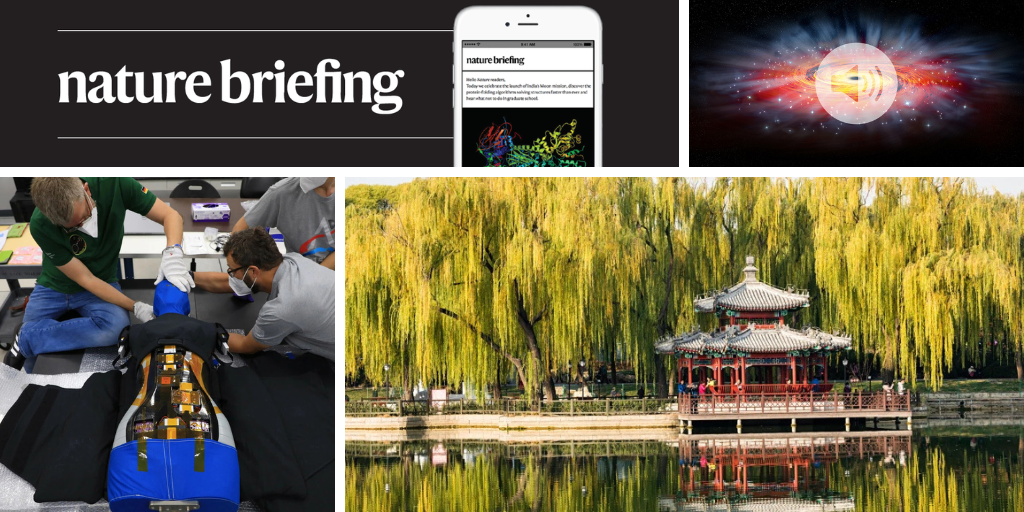
Researchers attach a prototype radiation-protective vest to a mannequin named Zohar that flew on NASA's Artemis I mission in 2022.Credit: NASA/DLR
A protective vest that was worn by a woman-shaped mannequin on the uncrewed NASA Artemis I mission could shield astronauts from some of the harmful radiation that occurs in deep space. The lightweight vest, made from a durable plastic rich in particle-blocking hydrogen atoms, would be more efficient than a heavy shield that covers an entire spacecraft. Measurements taken when the spacecraft flew through the high-radiation inner Van Allen belt suggested that the vest could block 40–60% of a solar storm’s radiation, sparing astronauts the equivalent of more than six months’ worth of steady deep-space radiation exposure.
Some of the species of trees planted in urban areas — species that are often chosen for their quick growth and climate resilience — have an unfortunate downside: they emit high levels of volatile organic compounds (VOCs) that contribute to ozone pollution. VOCs react with nitrogen oxides (NOx) to create ozone, which can cause breathing difficulties. A study in Beijing found that vegetation accounted for about 10% of the total VOC emissions during a period in 2021. Reducing NOx emissions, which mostly come from vehicles and industry, would help keep ozone in check.
A personalized mRNA vaccine for melanoma reduced the risk of the cancer returning in a phase III clinical trial, the companies behind the trial announced this week. The vaccine is the first mRNA-based cancer treatment to show success in a late-stage trial, which is “incredibly exciting”, says mRNA researcher Seth Cheetham. The results could have implications beyond the field of cancer, too, says Sam Barrell, the chief executive of medical research charity LifeArc. It could help to build confidence in more-tailored approaches to treatments for rare conditions that are often driven by unique genetic mutations.
The US National Science Foundation (NSF) will award about 30% fewer new research grants this fiscal year than in the last one, Nature has learnt. The drop continues a pattern that began last year. The decline in new grants for the rest of 2026 can be attributed mainly to US$1 billion of the agency’s $8.8-billion budget being allotted to a project called Grand Research Challenges, which is aimed at scientific fields such as advanced materials and artificial intelligence, say anonymous NSF staffers. (Nature | 6 min read) (Source: Grant Witness/NSF data)
Molecular biologist Francesca Granata studies a rare condition called porphyria that can cause burning or itching skin — a path she chose after her own diagnosis in 2008. She and other researchers who study their own rare diseases told Nature that their personal experience with an illness enables them to empathize with other patients, driving them to find better therapies for themselves and others. There is potential bias in studying their own disease, but contributing to an increased understanding of their condition can be deeply fulfilling, they say.
In high deserts and other drylands, the surface can be mostly covered with biocrust: a slow-growing layer of bacteria, algae, fungi, lichen and mosses. This living layer both produces and reinforces soils by shielding the ground from UV radiation, unlocking nutrients and trapping water. It also prevents erosion, supports the growth of native plants and stops dust from shedding into the air. But rising temperatures affect the crust’s ability to thrive, so researchers are doing careful field experiments to determine how to bolster and harness the benefits of biocrust.
A bank employee notices a tiny error in the ledger in the latest short story for Nature’s Futures series.