// PC GAMER — GAMING
DLSS 4.5 Ray Reconstruction is a definite improvement but path traced fidelity is still not a 100% solved issue
Nvidia has rounded out the DLSS 4.5 stack… now where's DLSS 5?
When you purchase through links on our site, we may earn an affiliate commission. Here’s how it works.
Nvidia's new DLSS 4.5 Ray Reconstruction feature is laser-focused on trying to fix the second most annoying thing about ray traced or path traced games: visual artifacting. Yes, the lighting effect does deliver the most accurate-looking lighting and shadows in games, but in motion there is a definite visual weirdness added into scenes. And that weirdness generally comes from the denoising pass designed to turn the low-fidelity path traced image, with its limited number of rays, into a fully realised frame.
Leave a game's viewport still and the scene will pretty rapidly come together to make a sharp, convincing image. Shift that around, or have that scene filled with moving objects or characters and you're going to see the sort of visual trails you might only have been used to in the warehouse parties of your early twenties. Just me?
The issue is that it's way too expensive in terms of raw compute to trace every single photon/pixel that would otherwise make up a fully traced scene. Even with the current method of tracking a far smaller representative sample of rays bouncing around the geometry of your game world it's still incredibly demanding of your PC's hardware.
This is, by the way, the most annoying thing about ray traced or path traced games: the amount of graphical horsepower the tech demands over pre-baked lighting techniques. The huge performance hit it involves is punitive for all but the most powerful GPUs, and we are still no closer to solving that right now.
So we still have to use small numbers of tracked rays to create an approximate scene which looks something like this:
But that doesn't look great if you're trying to make a convincing world, though I guess there's something to that aesthetic in a sort of 3D ASCII kind of way. Anyway, to realise this image into a production ready frame you need to use a denoiser to fill in the blanks between the sampled rays, and the hand-tuned denoisers track and group pixels across multiple frames, to give them access to more samples. They then use these neighbouring pixels to interpolate and blend the scene together.
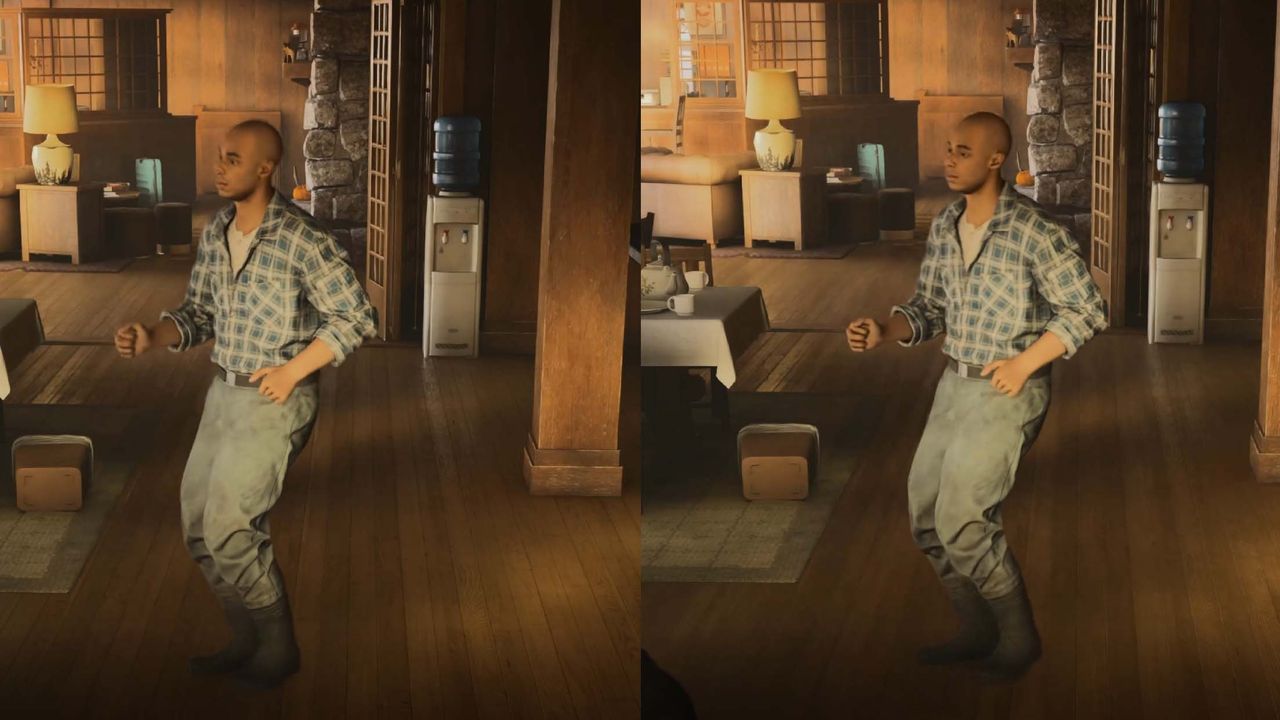
As I said, that's fine for a static image, but those pixels don't stay representative for long and in motion they break down, adding in artifacting to a scene and smearing detail away from textures. This is where the original Ray Reconstruction feature came in, replacing the hand-tuned denoisers with an AI-based denoiser working alongside Nvidia's upscaling models, to generate more accurate pixels in between those sampled rays.
Keep up to date with the most important stories and the best deals, as picked by the PC Gamer team.