// NATURE NEWS — SPAZIO & SCIENZA
Automated prototyping of genetic codes
Nature
(2026) Cite this article
The standard genetic code uses 64 codons to encode 20 canonical amino acids across domains of life. New-to-nature genetic codes enable new chemistries, therapeutics and ecosystem engineering, but recoding the genome of an organism is exceptionally challenging1,2,3,4,5,6. Here we describe automated genetic tRNA expansion (AGENTEX) for multiplexed robotic prototyping of genetic codes in cell-free translation systems. Two Watson–Crick interactions in the ribosomal large subunit (LSU) mediate recognition of the 3′ CCA end of tRNAs, preventing tRNAs with alternative 3′ sequences from being accommodated during translation7,8. Building on these interactions, we investigated the extent to which non-CCA-3′ tRNAs (otRNAs) would be aminoacylated by natural aminoacyl tRNA synthetases (aaRSs), allowing pools of otRNAs to specify unique genetic codes using ribosomes with altered LSU. We developed multiplexed and automated methods to read aminoacylation in libraries of synthetic tRNAs. We discovered that the tRNA 3′ end shows remarkable flexibility to mutation, allowing aminoacylation of most otRNAs by all Escherichia coli aaRSs. Building on our discovery, we developed cell-free translation systems enabling compressed genetic codes of 34 aaRSs for 34 codons. Using AGENTEX, we evaluated two genetic codes alongside the standard genetic code, with non-standard amino acid incorporation and reassignment of up to three codons. Our findings have implications for the design of radically new translation systems, the synthesis of biopolymers with several instances of non-standard monomers, and understanding of possible past and future genetic codes.
Synthetic genetic codes1,2,4,5 have enabled construction of organisms with new properties such as increased virus resistance and reduced horizontal gene transfer2,9,10, as well as production of genetically encoded materials11,12, therapeutics13 and biocatalysts14. Using engineered ribosomes15,16,17, tRNAs18 and aaRSs18,19, genetic code expansion has enabled the introduction of more than 400 non-standard amino acids (nsAAs) into proteins in living cells20 and synthesis of sequence-defined polymers21,22,23. However, reassigning more than a handful of sense codons across an entire genome3,6 remains challenging, as does incorporation of multiple nsAAs into polypeptides with high purity. Much more radical redesign of translation systems is required to achieve complete control, from genetic sequence space to sequence-defined chemistry.
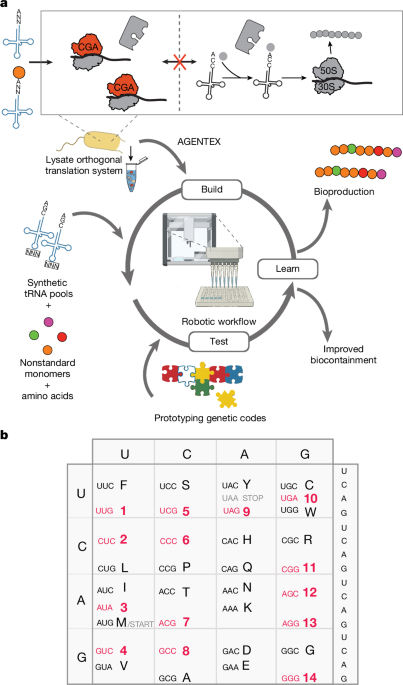
Given the challenges of genome synthesis and editing, a fully automated workflow to design and test new genetic codes can accelerate genome engineering, push genomes beyond what nature has evolved and allow unprecedented control over sequence-defined polymer synthesis (Fig. 1a). Compressing the 64-codon near-universal genetic code to only 20 sense codons, one start codon and one stop codon liberates 14 codons for non-standard building blocks (Fig. 1b and Extended Data Fig. 1). We predicted a modular, automated, data-driven redesign cycle. By combining custom lysate-based translation systems with synthetic pools of tRNAs carrying engineered anticodons, we can rapidly prototype alternative genetic codes and evaluate their performance in polypeptide synthesis (Fig. 1a).
a, Ribosomes containing G2251C and G2553C mutations in the large subunit (CGA ribosomes) specifically accommodate tRNAs with 3′ CGA ends (otRNAs) and do not accept natural tRNAs for translation. Natural aaRSs can aminoacylate all otRNAs in a one-pot reaction, allowing their use in translation. A cell-free translation system (lysate) is generated by lysing cells containing CGA ribosomes and used for subsequent translation tests in an automated workflow. Each genetic code is synthesized as a pool of otRNAs that are robotically produced and introduced into the lysate. For example, a single tRNA for each amino acid can be provided, producing a compressed gen