// NATURE NEWS — SPAZIO & SCIENZA
3D bulk-resolved g-wave altermagnetic order parameter in CrSb
Nature
volume 656, pages 854–860 (2026) Cite this article
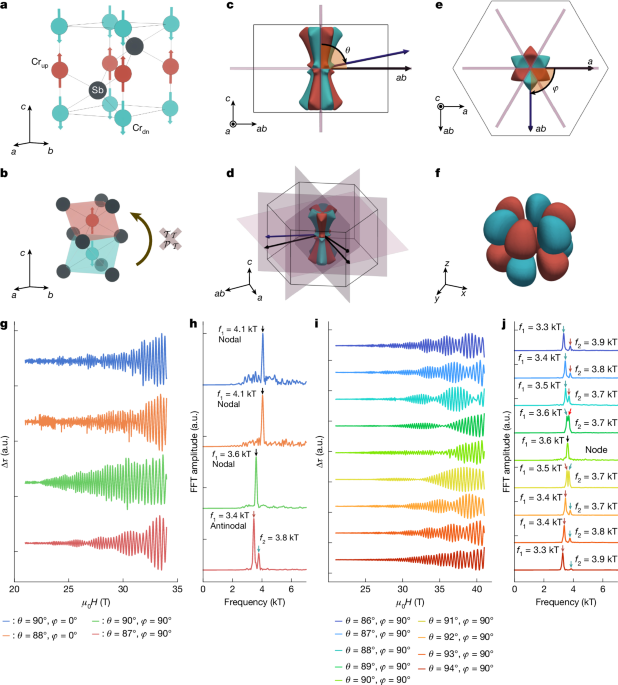
Electronic phases of matter, such as magnetism and superconductivity, are defined and distinguished by their order parameters quantifying the spontaneous symmetry breaking underlying each phase. Simple cases include the uniform magnetization of ferromagnets1,2 and the isotropic gap function of conventional superconductors3. Unconventional superconductors4 often have a nodal gap function, in which the gap changes sign at nodes on the Fermi surface. This concept of unconventional or nodal order parameter symmetry has recently been extended to numerous magnetic systems5,6,7,8, including altermagnets9,10,11,12,13, in which up- and down-spin species have non-degenerate Fermi surfaces. Here we demonstrate that magnetic quantum oscillation14 measurements can provide a high-resolution, bulk-sensitive, three-dimensional (3D) mapping of the order parameter in an unconventional magnet. By rotating a magnetic field through high- and low-symmetry directions of the CrSb Brillouin zone, we show that the altermagnetic band structure of this material leads to a reduction of symmetry for each spin-split Fermi sheet away from nodal orientations. In momentum space, the exchange splitting between up and down spins follows the profile of the \({{\mathcal{Y}}}_{4}^{-3}=yz\,(3{x}^{2}-{y}^{2})\) real spherical harmonic—analogous to a g-orbital of the hydrogen atom. Although notoriously difficult to resolve in unconventional superconductors, our work demonstrates that the order parameter symmetry of unconventional magnets can be precisely mapped by quantum oscillatory quasiparticle spectroscopy, establishing CrSb as a prototypical g-wave metallic altermagnet.
There are two traditional types of collinear magnetic ordering: ferromagnetism1,2, in which all spins point in the same direction, and antiferromagnetism15, in which the spin polarization alternates up and down from site to site. In an antiferromagnet, the magnetic structure can be decomposed into two magnetic sublattices, resulting in a doubling of the magnetic unit cell16 under translation. Recently, a third distinct classification was proposed, dubbed altermagnetism9,10,11,12,13. Like antiferromagnets, altermagnets possess alternating up- and down-spin orientations from site to site. However, the distinction is that in an altermagnet the spin sublattices are connected by rotational symmetries rather than just translation (or inversion). This leads to the lifting of Kramers spin degeneracy17 and a momentum-dependent non-relativistic spin splitting of the electronic band structures18. Therefore, altermagnetism represents a distinct form of ordering, in which the momentum-dependent spin-split property of ferromagnets is combined with the spin-compensated zero net magnetization of antiferromagnets, opening new opportunities for magnetic memory and spintronic device applications19.
Numerous altermagnet candidates have been identified from ab initio calculations9,10,19,20,21, with experiments on MnTe giving good empirical correspondence with theoretical expectations22,23,24,25. However, although many semiconducting or insulating materials have been identified, only a handful of metallic altermagnet candidates have so far been proposed. The realization of a metallic altermagnet, with an ordering temperature far above 300 K, would be particularly desirable for efficient electronic transport in technological device settings21.
Of metallic candidates, surface-sensitive photoemission spectra of RuO2 (refs. 26,27), KV2Se2O (ref. 28) and CrSb (refs. 29,30,31,32) have been interpreted to show hallmarks of altermagnetic spin splitting. However, for the case of RuO2, a variety of subsequent bulk-sensitive measurements33,34,35 cast considerable doubt on whether this material is an altermagnet. Further photoemission studies36,37 showed that this material seems to possess a topological surface state with Rashba-like spin spl