// NATURE NEWS — SPAZIO & SCIENZA
Synergistic degradation of fucoidans in the ocean
Nature
(2026) Cite this article
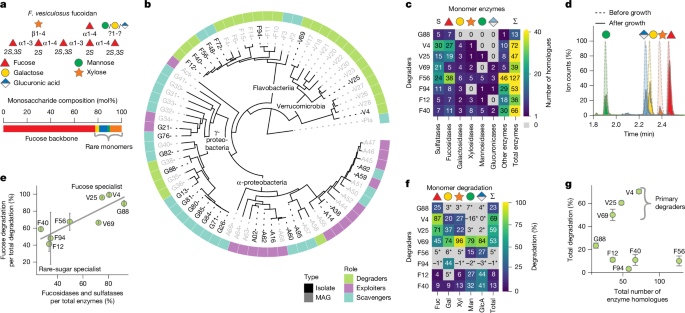
Fucoidans, a class of complex polysaccharides produced by brown algae and diatoms, contribute to long-term carbon sequestration owing to their resistance to microbial degradation1,2. Although individual microorganisms can break down portions of these polysaccharides3,4,5, it remains unclear whether complete breakdown is possible in nature and, if so, by what mechanisms. Here we show that fucoidans are degraded through synergistic interactions between specialized bacteria with complementary metabolic functions. Using metabolomic analysis of a reconstructed marine consortium, we uncovered metabolic guilds of bacteria that preferentially degrade either the sulfated fucose backbone or the side branches of rare monomers. This functional division of labour leads to an unexpectedly high number of synergistic interactions between different degraders that enhanced degradation efficiency up to 97.1%. Despite varying fucoidan structures across different types of algae6, the metabolic functions of degraders remained conserved, enabling quantitative prediction of degradation outcomes based on community and substrate composition. The frequent co-occurrence of functionally complementary fucoidan degraders in ocean metagenomes suggests that synergistic degradation is a globally relevant strategy. Our findings suggest that the environmental turnover of complex biopolymers depends not only on individual metabolic capabilities of degraders but also on ecological interactions shaped by substrate architecture. This work provides a mechanistic framework for understanding carbon cycling in the ocean and for engineering synthetic microbial consortia to degrade recalcitrant polysaccharides.
Plant and algal polysaccharides are among the most abundant and diverse biopolymers on Earth7,8. Their degradation by microbial communities drives carbon cycling9,10, promotes gut health11 and enables sustainable biotechnologies12,13. As the main component of protective extracellular matrices in plants and algae, the chemical diversity of polysaccharides has escalated a co-evolutionary arms race, driving the diversification of carbohydrate-active enzymes and their reshuffling among microbial degraders via horizontal gene transfer14,15,16,17. Although these distributed metabolic capabilities are evident in many microbial ecosystems, it remains unclear how multiple degraders coexist on a single complex polysaccharide resource and engage in synergistic interactions rather than competition18,19,20,21,22,23. Consequently, we lack a quantitative, mechanistic framework linking the metabolism and interactions of individual degraders to degradation on a community level. This gap hinders our understanding of microbial contributions in carbon cycling and our ability to design microbial consortia for efficient degradation of diverse substrates.
In marine ecosystems, brown algae and diatoms produce the recalcitrant polysaccharide fucoidan, giving them a key role in carbon sequestration. They account for one-fifth of marine primary production and, through sinking biomass and particles, export 5 GtC yr−1 to the ocean depths, where the carbon can be stored for millennia24,25,26. These natural processes are increasingly harnessed in brown algal aquaculture, which is projected to contribute at least 0.5% of the 1 GtCO2 yr−1 sequestration target set for nature-based climate solutions by 205027. Fucoidan is a major agent of algal carbon export, as it constitutes 25–50% of the cell wall and mucilage6,28, promotes particle formation, and resists microbial degradation for up to several months1,29. This stability is probably attributable to its complex structure, which comprises a sulfated fucose backbone that varies across algal species in linkage patterns and sulfation, as well as in the heterogeneous composition and linkage architecture of non-fucose side chains6. Because of this complexity, only a few bacterial species ar