// NATURE NEWS — SPAZIO & SCIENZA
Granule cells reorient cortical trajectories to separate contexts
Nature
(2026) Cite this article
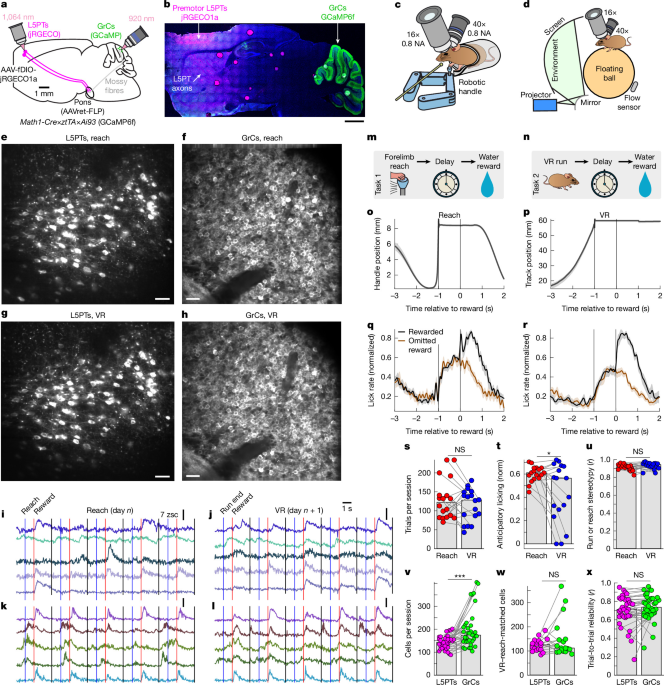
To learn effectively, animals must generalize across related contexts yet distinguish between them. Generalization relies on low-dimensional neural manifolds throughout the neocortex1,2, which accelerate learning by constraining neural activity to task-relevant axes3.Conversely, context separation is thought to depend on neural expansion layers that can project information into high-dimensional feature spaces4,5, most famously cerebellar granule cells (GrCs)6,7,8. Here, to investigate the generalization–separation trade-off, we simultaneously imaged key nodes in the universal cortico-cerebellar pathway9—premotor layer 5 pyramidal tract (L5PT) and GrCs—in mice during parallel learning of two distinct skills with a shared temporal structure. Rather than expanding the cortical representations, GrCs retained their low-rank encoding of each task. Across contexts, despite stable cortico-cerebellar coupling, L5PT activity patterns generalized, whereas GrC patterns temporally remapped. But rather than independently scrambling, GrC populations remapped coherently: their low-dimensional trajectories ‘rotated’ apart between tasks, separating the contexts while preserving the cortical geometry of each. Moreover, GrC trajectories diverged most strongly in expert mice. This suggests a fundamental architectural division of labour: the cortex provides invariant dynamic primitives for smooth generalization, whereas cerebellar activity reconfigures them to drive context-specific output.
This is a preview of subscription content, access via your institution
Access Nature and 54 other Nature Portfolio journals
Get Nature+, our best-value online-access subscription
Prices may be subject to local taxes which are calculated during checkout
The data in this study have been publicly deposited in Dryad at https://doi.org/10.5061/dryad.9p8cz8x0p (ref. 59). Source data are provided with this paper.
Code is publicly available via Zenodo at https://doi.org/10.5281/zenodo.21341571 (ref. 60).
Bernardi, S. et al. The geometry of abstraction in the hippocampus and prefrontal cortex. Cell 183, 954–967 (2020).
Article
CAS
PubMed
PubMed Central
Google Scholar