// NATURE NEWS — SPAZIO & SCIENZA
Spontaneously charged water drops induce corrosion
Nature
(2026) Cite this article
Water drops spontaneously become electrically charged when moving on different surfaces, such as plant leaves, insect wings, building walls, window glass and plastic1,2,3,4,5,6,7,8,9. This process, known as contact or sliding electrification, is analogous to tribocharging between solids10,11,12,13. The electric potential of water drops charged in this way can exceed 1 kV (refs. 14,15,16). A vital but as yet unanswered question is whether the charge in water drops causes corrosion. Here we analyse the effect of series of water drops hitting metal surfaces, which are protected by a non-conductive coating. Before hitting the coated metal, the drops acquire a charge spontaneously by sliding over an insulating surface. We demonstrated that these charged drops can cause the coating to break down electrically and lead to corrosion of the metal. As spontaneously charged water drops form naturally, this previously overlooked corrosion mechanism may contribute to the degradation of cultural heritage sites, buildings, ships, cars and other metal components. Our findings can improve anticorrosion strategies and emphasize the need for protective materials capable of resisting charge-induced damage from water drops.
Metal corrosion is a serious economic and safety issue facing modern society17,18,19. Outdoor metal products are particularly vulnerable to water drops from rain, dew, ocean waves and melting snow20,21,22,23,24,25. Using anticorrosion coatings is the simplest and most effective method; however, these coatings inevitably degrade over time26,27. Conventional understanding attributes the coating failure induced by water drops mainly to two mechanisms: physical abrasion caused by moving drops28,29,30 and chemical degradation from acidic substances and pollutants in the drops31,32,33.
In recent years, it has been demonstrated that water drops moving over insulating solid surfaces can spontaneously acquire a charge and deposit an opposite charge to the surface1,2,3,4,5,6,7,8,9. Hereby the electric potential of charged water drops can reach several thousand volts14,15,16, depending on the specific materials involved and the thickness of the insulating layer. Here we show a previously overlooked corrosion mechanism induced by water drops: spontaneously charged water drops, whether hitting or sliding, can cause strong electric fields, leading to dielectric breakdown and cause degradation of the protective coating (polymer or oxide layer), thereby allowing subsequent corrosion of the metal substrate. Typically, ‘degradation’ is more commonly used to describe the damage to coatings. However, according to the International Union of Pure and Applied Chemistry (IUPAC), ‘corrosion’ also refers to materials other than metals, such as ceramics and polymers34. In the following discussion, we use ‘corrosion’ to refer to the damage of both coatings and metals.
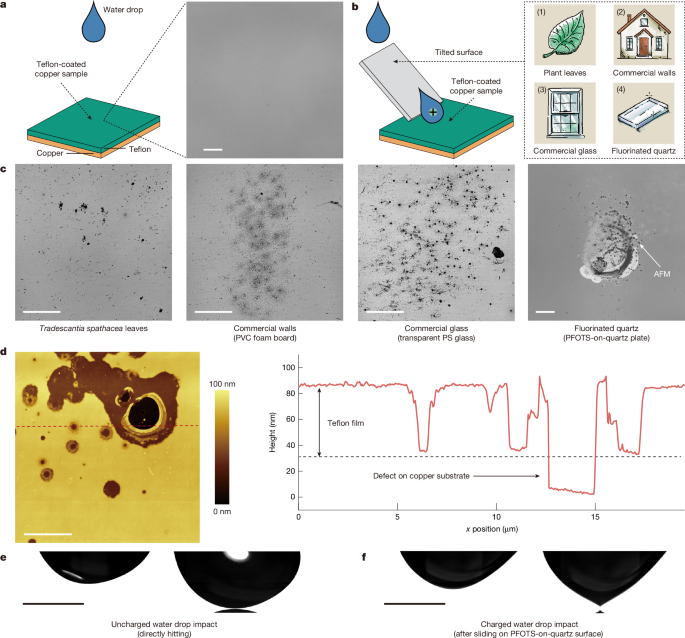
As a reference, we studied electrically neutral water drops directly falling onto a sample (Fig. 1a). 35-μl water drops were continuously released at 12-s intervals from a height of 4 cm and directly dropped onto a Teflon-coated copper sample. Usually, water drops in nature, such as rainwater, are not distilled water but contain some salt, whose concentration depends on local environmental conditions35,36. In our experiments, the water drops contained 1 mM NaCl. We made the sample by sputtering a 35-nm-thick layer of copper onto a smooth quartz plate. Then a 60-nm-thick Teflon film was deposited by dip-coating onto the copper substrate from a 1-wt% Teflon AF 1600 solution. Finally, the samples were annealed at 160 °C under vacuum for 24 h. We chose the Teflon coating because it is chemically robust. The samples were tilted by 10° so that water drops ran off before the subsequent drops hit the surface. We analysed the sample surface by reflection mode confocal microscopy after 3,000 water drops had directly hit it. This analysis