// ARS TECHNICA — FINANZA
Bentley takes us for a ride in its new EV, the Torcal
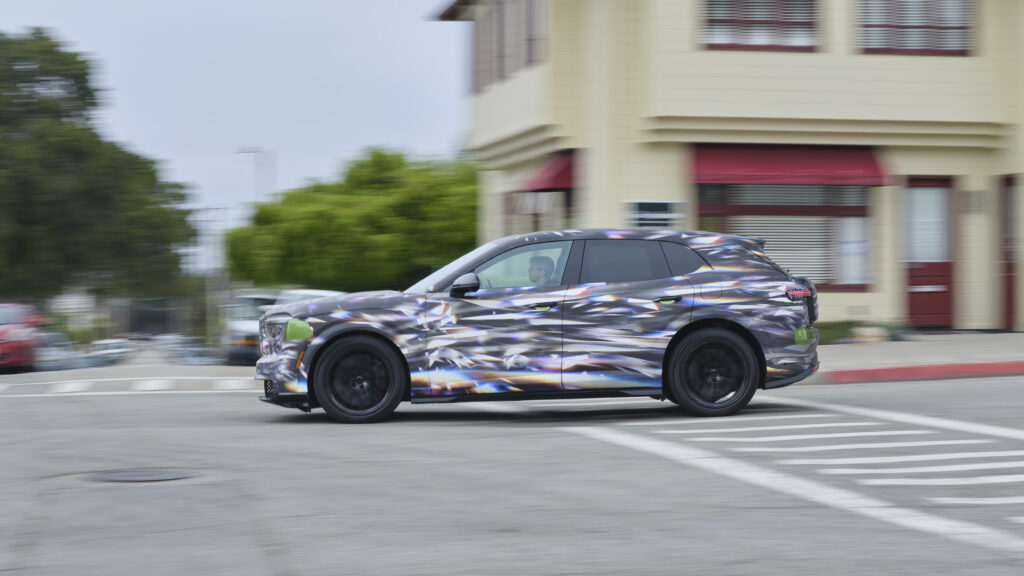
The electric Torcal will be Bentley’s entry model and cost less than a Bentayga.
MONTEREY, Calif.—Next month Bentley will reveal its first battery-electric vehicle. The British automaker is no stranger to electric motors; it now offers plug-in hybrids across its range, even replacing the Continental GT’s W12 with a new plug-in hybrid V8. The addition of electric motors perfectly suits the marque: what’s more Bentley than waves of effortless torque, after all? But until now, there’s always been a combustion engine along for the ride. Not so the Torcal.
Clad in plastic and wrapped in a multi-hued dazzle camouflage, it’s shorter in length and height compared to a Bentayga, although it is similarly voluminous on the inside thanks to the inherent packaging efficiencies of an EV. If the proportions remind you of a Porsche Cayenne EV, that’s because the two share quite a lot of the same basic engineering, albeit reworked by Bentley to suit its needs. The target is 300 miles (482 km) in EPA range or 600 km (373 miles) under WLTP, from the battery pack, and like the Cayenne, expect 400 kW DC fast-charging.
Don’t expect the Cayenne’s quadruple-figure power output, though. “We’ll be well over a thousand newton-meters of torque [737 lb-ft], which is one of the sort of enabling pillars of the technology, which is fantastic. There’ll be over 850 PS [838 hp/625 kW], but we’re not chasing four figures,” said Martin Page, product line director for the Torcal.
“Our calibration for the linear performance of the car has been focused on how do we make the progression feel effortless, feel, again, confidence-inspiring, and we feel at the limit of comfort for our customers so that, again, they feel like they can access the full potential of the car on a regular basis. And that’s been the kind of guiding principle throughout, is that access to it,” Page said as he drove us around Pebble Beach in a preproduction car that has been here in the US doing localization testing.
From the back seat, you might not have known it was an EV. “These are luxury items, an emotional purchase. So we wanted to make sure that we maintained this kind of emotional connection to the car. And sound, we felt was really important,” Page said. After benchmarking some competitors, Bentley decided to dig into its archive instead, “and we came back to the engines out of the Continental and Turbo; quite a heavy, low-revving, high-torque [engine],” he said.
Rather than sample one of its 6.75 L V8 engines, the way a games studio might when simulating a car, Bentley went for a more human touch.
“We chose to use artists, humans to recreate the pattern,” Page said. “So they play the firing order, the V8 on drums. … If you think about the actual mechanical engine itself, it is imperfect. It has tolerances in it. So it has natural variation in the idle beat. And the people we’ve used to do the drumming, they’re experts in the field, but again, they’re humans. So they have natural imperfections in the way they have gone through the percussion,” he said.
The effect is subtle but convincing from the inside of the car, and because it’s a Bentley, the sound is never loud or obnoxious. It can be heard outside the car, too, but Bentley hasn’t gone the route Dodge did, fitting a loud external speaker to the Charger EV. The sound is mapped to the amount of load on the powertrain “so that you get a really natural experience when you’re in a high load scenario, up a hill or in a dynamic situation where you get that visceral level of kind of engagement with the car,” Page said.
Torcal might be Bentley’s new entry point, but it’s anything but basic. Fitted with the same 48 V dual-valve damper active ride comfort system that we’ve enjoyed on the Porsche Panamera, from an occupant’s perspective the Torcal glides down the road with as much ride comfort as a Flying Spur sedan. But from the driver’s seat, I’m told the experience is closer to the Continental GT, the extra height of the EV compensa