// NATURE NEWS — SPAZIO & SCIENZA
Daily briefing: Thousand years of coral show El Niños are getting stronger
Search author on:
PubMed
Google Scholar
Hello Nature readers, would you like to get this Briefing in your inbox free every day? Sign up here.
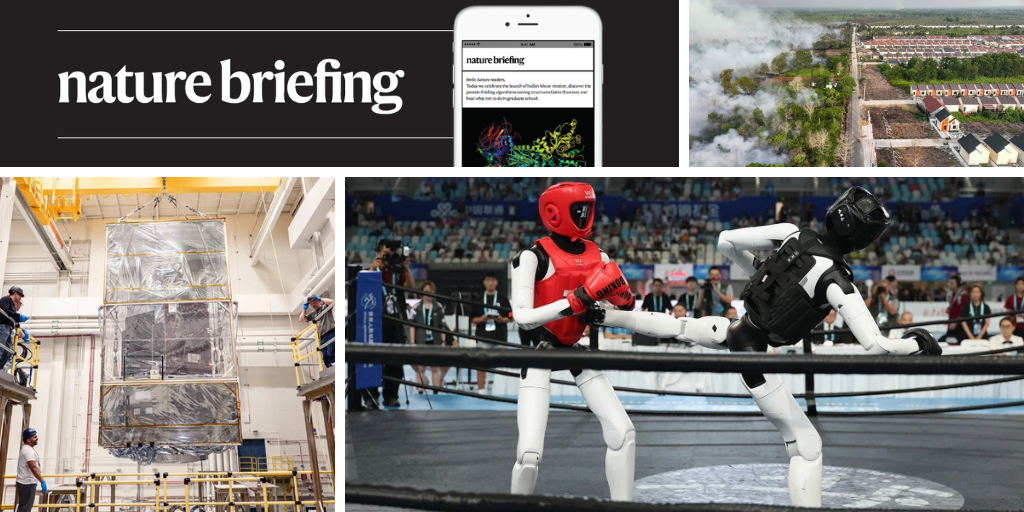
Robots compete during a combat event at the second World Humanoid Robot Games in Beijing. Credit: Lintao Zhang/Getty
At the second annual World Humanoid Robot Games in Beijing, a human-sized robot sprinted faster than any human has before, among other physical feats. But when it comes to tasks most of us would actually want a robot to do, sprinting is low on the list. “If I ask you which is harder — folding laundry or doing a backflip — most people will say folding laundry is way easier,” says computer scientist Karen Liu. “But for humanoids, doing a task that we do in our daily lives is actually way harder than a backflip.”
A reconstruction of sea surface temperatures based on the geochemistry of Galápagos coral skeletons suggests that more strong El Niño events have been happening over the past 100 years as fossil-fuel emissions heat the world, compared to the millennium before the industrial revolution. However, the interactions between the ocean and the atmosphere that drive El Niño events are complex, so there is still uncertainty about how cycles of Pacific temperature will change this century. “Corals give us a time machine to look into the past,” says palaeoclimatologist Julia Cole. “They don’t give us a time machine to look into the future.”
On 30 August, NASA’s long-awaited Nancy Grace Roman Space Telescope is planned to make its ascent into Earth’s orbit. With its crisp infrared vision and expansive field of view, Roman is a powerhouse: one month of Roman’s Milky Way observations would take about a century for the Hubble Space Telescope. It should give scientists insights into the early Universe and the mysterious force called dark energy, and give a huge boost to the number of planets we can detect outside the Solar System.
The Nancy Grace Roman Space Telescope undergoes vibration testing before its launch, scheduled for 30 August. Credit: Sydney Rohde/NASA/Roman Space Telescope (CC BY-NC-ND 4.0)
An ex-soldier and the self-aware AI living in his head go out for ice cream in the latest short story for Nature’s Futures series.
Andrew Robinson’s pick of the top five science books to read this week includes a new book by forest ecologist Suzanne Simard — who popularized the idea of the ‘Mother Tree’ — a history of the unconscious mind and a look at the wide-ranging health impacts of the COVID pandemic.
Why extreme temperatures are expected to weaken ocean carbon sinks — plus, how mitochondrial injections could treat vision loss and astronaut vests cut radiation exposure in half.