// NATURE NEWS — SPAZIO & SCIENZA
Structure and operating principles of a monkeypox virus replisome
Nature
(2026) Cite this article
Poxviruses are double-stranded DNA viruses with large genomes. Among them, monkeypox virus (MPXV) has been responsible for two recent public health emergencies as declared by the World Health Organization1. The MPXV polymerase comprises three subunits—a catalytic subunit (F8) and a heterodimeric processivity factor (A22 and E4). The viral polymerase must coordinate activities with the hexameric helicase–primase (E5) to initiate replication of the viral genome2. Although structures of MPXV E5 (refs. 3,4) and the polymerase5,6,7 in isolation are available, how they assemble into a functional replisome remains unclear. In isolation, E5 is in an autoinhibited conformation and has very weak helicase activity3,4, and the mechanism for helicase activation is unclear. Here we used cryo-electron microscopy to determine the structures of DNA-bound MPXV replisomes comprising the polymerase holoenzyme (F8, A22 and E4) and the E5 helicase hexamer. We show that, during replisome assembly, E5 undergoes large-scale conformational changes that allow two of its primase domains to interact with the polymerase F8 thumb and A22 subunit. Biochemical assays and single-molecule experiments reveal that this E5 conformational change is coupled to helicase activation and enhances primase activity. Taken together, these findings identify fundamental mechanisms governing coordinated helicase and polymerase activities during DNA replication for an important class of viral pathogens.
Since 2022, MPXV has affected over 140 countries and resulted in more than 179,000 laboratory-confirmed cases8. The most recent wave of infections was fuelled by the clade Ib variant, with evidence of sustained human-to-human transmission and global spread9. Another poxvirus is variola virus, which causes smallpox, one of the most devastating diseases known to humanity before it was eradicated.
Poxviruses replicate in the cytoplasm of host cells. Their genomes encode proteins for DNA replication and gene expression2 and have inverted terminal repetitions with incompletely base-paired hairpin loops connecting the two DNA strands, making a continuous polynucleotide chain2. The proteins that replicate the viral genome include the DNA polymerase (F8, A22 and E4) and the hexameric helicase–primase E5. The DNA polymerase of poxviruses is a family B DNA polymerase, and the catalytic subunit, F8, contains canonical fingers, palm and thumb domains, an N-terminal domain (NTD) and a 3′–5′ proofreading exonuclease (Exo) domain5. F8 exonuclease activity also promotes virus genetic recombination10,11. In the assembled polymerase holoenzyme, A22 serves as a bridge connecting F8 and E4 (refs. 5,6,12). The N-terminal region of viral helicase–primase E5 contains a primase domain, the enzymatic activity of which is essential for viral DNA replication13. The C-terminal region of E5 contains a superfamily-3 helicase and forms a hexameric ring with a central channel for ssDNA translocation in the 3′–5′ direction14,15. The single-stranded DNA (ssDNA)-binding protein I3 is also essential for viral replication16,17, as is a viral DNA or host DNA ligase18.
Previous studies with full-length MPXV E5 have shown that it has weak activity unless the primase domains are deleted3,4,19. Structures of E5 have revealed that the primase domains block the E5 ssDNA channel, suggesting an autoinhibited conformation3,4. How E5 transitions from an autoinhibited conformation to an activated state is unclear.
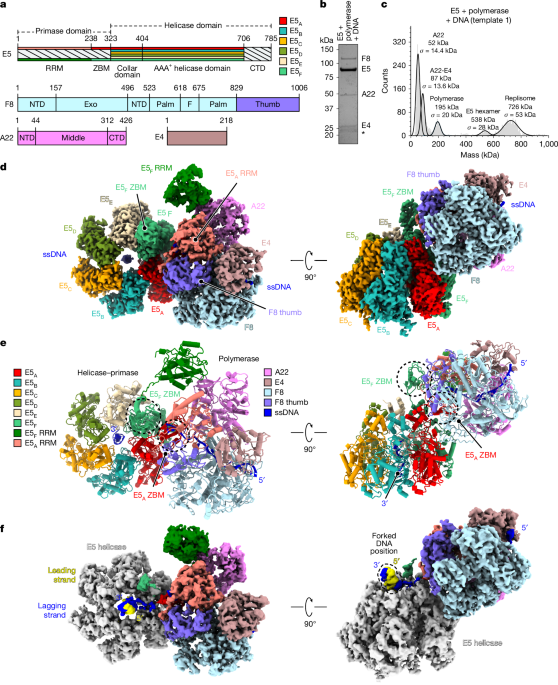
Here we determined cryo-electron microscopy (cryo-EM) structures of DNA-bound MPXV E5 helicase–primase in a complex with the DNA polymerase holoenzyme. We used biochemical assays and single-molecule experiments to show that conformational changes that occur when E5 interacts with the polymerase result in helicase activation and enhance E5 primase activity.
We purified E5 (residues 1–785) and the polymerase holoenzyme (F8, residues 1–1006; A22, residu