// NATURE NEWS — SPAZIO & SCIENZA
Antimatter ‘tag’ used to detect elusive particle decay
Matt Kenzie is in the Department of Physics, University of Cambridge, Cambridge CB3 0US, UK.
Search author on:
PubMed
Google Scholar
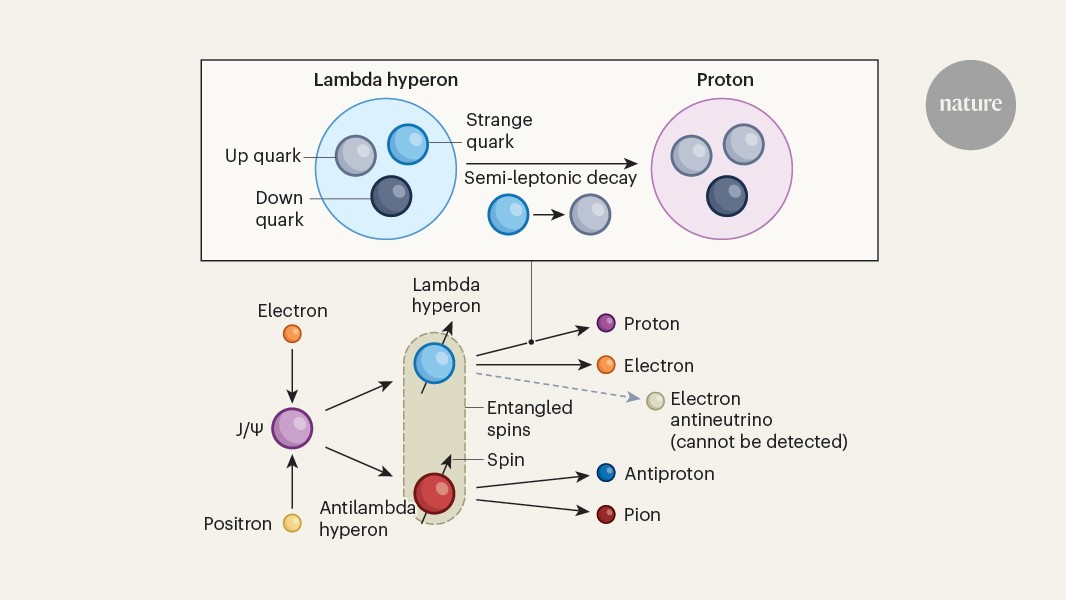
The protons and neutrons that make up the majority of everyday matter consist of fundamental particles called up quarks and down quarks. Less common is the unstable strange quark, which can turn into an up quark. This transformation, which serves as a key test of conventional physics theory, can be measured in the decay of particles called lambda hyperons. However, over the past 35 years, this decay has received little experimental attention because some of its characteristics could not be measured. Now, in a paper in Nature, the BESIII Collaboration1 reports an experiment that ‘tagged’ the lambda hyperon decay through quantum entanglement with the particle’s antimatter partner. The authors find that a key decay parameter is consistent with conventional theory, in conflict with previous measurements.
Access Nature and 54 other Nature Portfolio journals
Get Nature+, our best-value online-access subscription
Prices may be subject to local taxes which are calculated during checkout
The BESIII Collaboration. Nature 657, 92–97 (2026).
Seng, C.-Y., Galviz, D., Marciano, W. J. & Meißner, U.-G. Phys. Rev. D 105, 013005 (2022).
Cabibbo, N., Swallow, E. C. & Winston, R. Annu. Rev. Nucl. Part. Sci. 53, 39–75 (2003).
Dworkin, J. et al. Phys. Rev. D 41, 780–800 (1990).