// NATURE NEWS — SPAZIO & SCIENZA
Immune therapy engineered inside the body eases multiple sclerosis
Rachel Fieldhouse is a reporter for Nature in Sydney, Australia.
Search author on:
PubMed
Google Scholar
Symptoms for sixteen people with multiple sclerosis or other autoimmune conditions improved after receiving a treatment that produced disease-fighting immune cells inside their bodies, according to results1 from a small clinical trial. Researchers say the results are exciting but the treatment needs to be tested in more people.
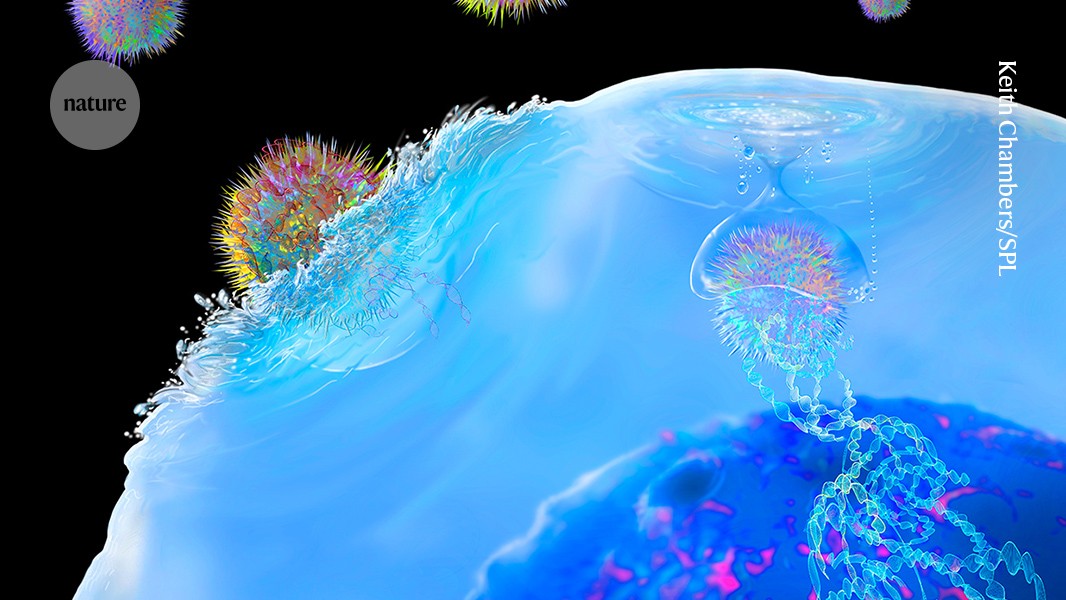
The latest trial, published this week in The New England Journal of Medicine, used a modified virus to transfer genetic instructions for making chimeric antigen receptors (CARs) on participants’ immune cells, known as T cells. The CAR T cells target autoantibodies expressed by B cells, another type of immune cell, which attack the body’s own healthy tissue in people with autoimmune diseases.
“This is a very exciting proof-of-concept study” for in vivo CAR-T-cell therapy, which is made inside the body, says David Simon, a clinician-researcher at the Charité — University Medicine Berlin. In vivo therapy is cheaper and faster to produce than is conventional CAR-T-cell therapies that are made in a laboratory, he adds.
Conventionally, CAR-T-cell therapies involve collecting T cells from a person’s blood and editing them in the lab to produce CARs. The tweaked cells are then reintroduced to the body. Ex vivo CAR-T-cell therapies are used to treat blood cancers, and clinical trials are under way for autoimmune diseases such as lupus.
Developing an in vivo CAR-T treatment for any disease is “a big achievement”, says Bing Du, an immunologist at East China Normal University in Shanghai. The results are good and comparable with those for ex vivo CAR-T-cell therapy, he says.
Dai-Shi Tian, one of the trial’s lead investigators, says the team was encouraged by the results. “The responses are promising signals, but they are not yet definitive evidence of efficacy or permanent restoration of immune tolerance,” says Tian, a neurologist at Tongji Medical College at Huazhong University of Science and Technology in Wuhan, China.
The trial involved people with multiple sclerosis and other autoimmune conditions, including those that cause weakness or inflammation of a person’s muscles, or in which the immune system attacks the brain, spinal cord and eyes. The participants received a single injection of the viral cells into their bloodstream and were monitored for about six months.
The team used a virus called a lentivirus, designed by biotechnology company Shenzhen Genocury Biotech in China. Last year, another CAR-T-cell therapy using a lentivirus was shown to effectively treat blood cancer2.