// HACKER NEWS — CYBERSECURITY
Astronomers Detect a 10-Sided Structure in Saturn's Atmosphere
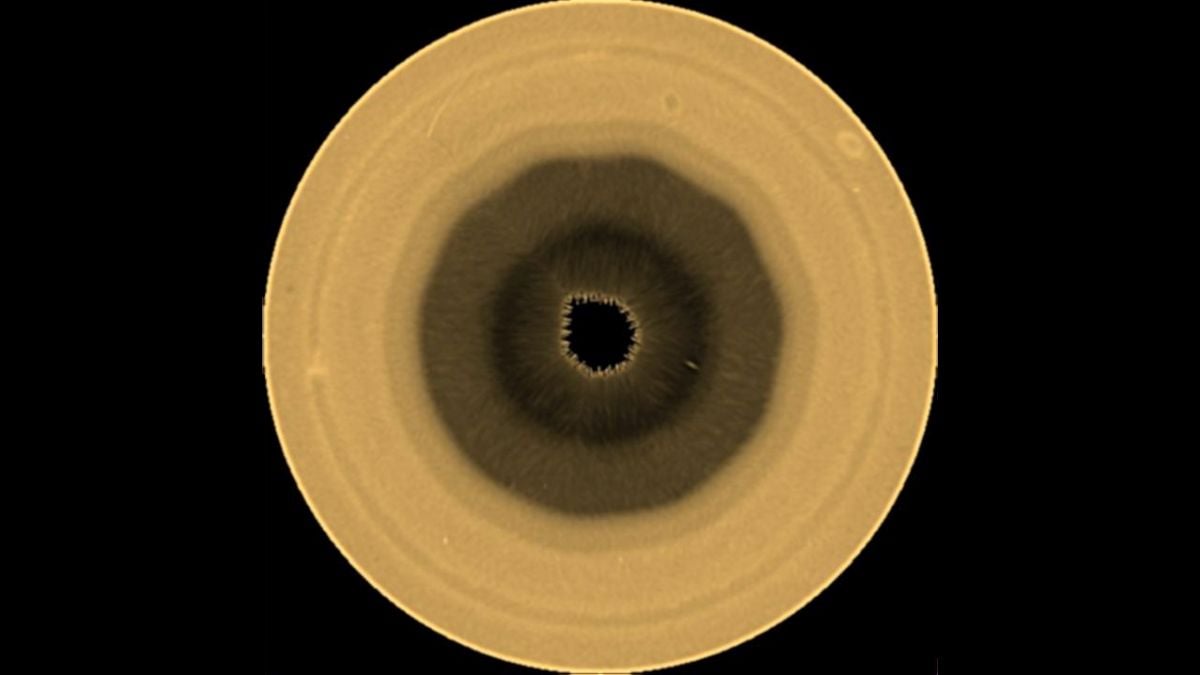
For decades, humanity has puzzled over the gas giant's enormous hexagon swirling around its north pole – a six-sided atmospheric structure unlike anything else known in the Solar System.
Now, it seems, that bizarre feature is not an isolated incident – and Saturn may have a propensity for polygons, rather than a passing whim.
Lurking around the planet's south pole, astronomers led by Agustín Sánchez-Lavega of the University of the Basque Country in Spain have spotted another giant polygon – and this one has ten sides.
"This discovery suggests that the hexagon is not as extraordinary as previously thought and that, in fact, the conditions in Saturn's atmosphere are such that polygonal waves can form in both hemispheres surrounding the polar regions," Sánchez-Lavega told ScienceAlert.
Saturn's most prominent and well-known feature is its magnificent system of icy rings, but the hexagon at its north pole would have to be a pretty close second.
It was first discovered in images from the Voyager probes in 1980 and 1981: a vast, six-sided atmospheric wave swirling around the pole at about 78.5 degrees latitude.
In the intervening decades, both the Hubble Space Telescope and the Cassini-Huygens Saturn probe also captured the strange feature, suggesting that it has remained stable for at least 44 years.
It's a weather phenomenon, but why it has such an almost perfect polygonal shape remains a mystery. And although scientists also thought Saturn's southern subpolar jets might produce a similar feature, none revealed itself across multiple searches.
Then, in 2024, polygon lightning struck for the second time.
In images from amateur astronomers, a dark, undulating line was visible around the planet's south pole.