// ARS TECHNICA — MONDO
Second complete map of a fruit fly brain completed
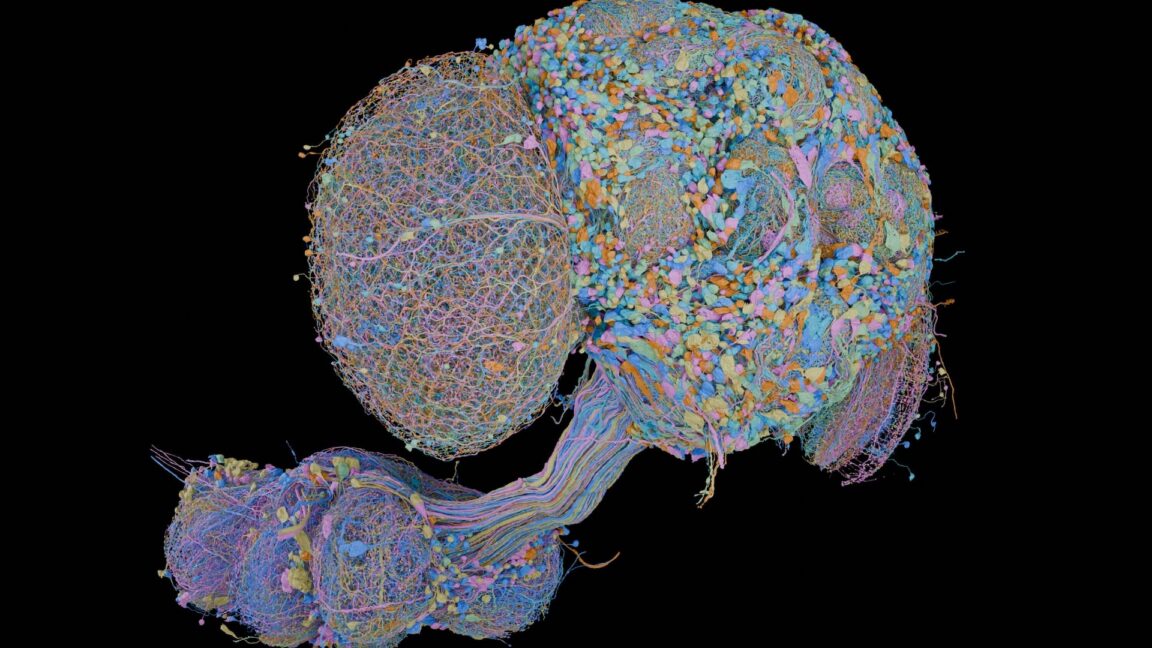
Every neuron and connection in the brain of a fly has been mapped—twice.
On Friday, researchers announced the completion of a map of every neuron in the brain of a male fruit fly. The “connectome” provides a tool that can accelerate neurobiology research. But it also provides an opportunity to do some science on its own, as the connectome of a female Drosophila had been completed earlier this year. The work also provided the team behind it the opportunity to refine tools that are likely to be applied to ever-more complex nervous systems, including (potentially) those of vertebrates.
The new work involved a collaboration between biologists at the Howard Hughes Medical Institute’s Janelia Research Campus and computer scientists at Google—both acknowledge that neither could have done the project without the other. Preparation of an entire brain for imaging at the necessary resolution requires a distinct set of skills, as does interpreting what those images indicate. But building a complete picture of the hundreds of millions of synapses in a brain as small as the fruit fly’s is a task that can’t be achieved by humans in a manageable amount of time.
The people behind the effort expect that in the long term, the effort will be worth it, as the connectome could give neurobiologists a valuable tool for understanding how the brain works.
Our interactions with the world begin with sensory input—the neurons that register sound, light, touch, and more. From there, most brain activity involves neurons communicating with each other. This communication transforms the inputs into signals the rest of the brain can interpret, routes information to relevant processing centers, and often produces some kind of output, from forming a memory to moving a muscle.
All that processing is dictated by which neurons have connections to others. For example, the visual system does some basic recognition of its own before passing the results to the brain’s visual processing centers. If those centers detect something like text, they can use connections to the language centers to interpret it, and so on.
To understand how a brain works, then, we need a catalog of the connections in the brain, since those dictate how information flows through its various systems. That catalog is a connectome.
In practical terms, a connectome is the list of every neuron in a brain, including its location in three-dimensional space, and the connections (termed synapses) it forms with other neurons. That’s more complicated than it may sound. Each neuron can form multiple, branched processes called axons, allowing it to form hundreds of connections to other neurons. So while the nervous system of the fruit fly consists of only roughly 150,000 neurons, and the brain contains only a fraction of those, the new work discovered over 300 million synaptic connections in the fly brain.
So how do you go about mapping something like that? Gerry Rubin, a senior group leader at the Janelia Research Campus and one of the senior authors on the new paper, described how things have changed considerably based on the complexity of the system. “I was a graduate student at the [UK’s Laboratory of Molecular Biology]… and when I got there in 71, they already bought this giant computer, and they had the idea that they were going to use machine vision and computers to assemble the C. elegans connectome,” Rubin said.
C. elegans is a small, transparent worm with just over 300 neurons and would seem to be a tractable system. “It took them about two years to realize that the computers were nowhere near powerful enough,” Rubin said, “and so they went with printing everything out on photographic prints and colored magic markers and circling neurons and tracing it by hand.”