// SPACE.COM — SPAZIO & SCIENZA
The rise of 'quantum gravity?' Einstein's theory seen in the quantum realm for 1st time
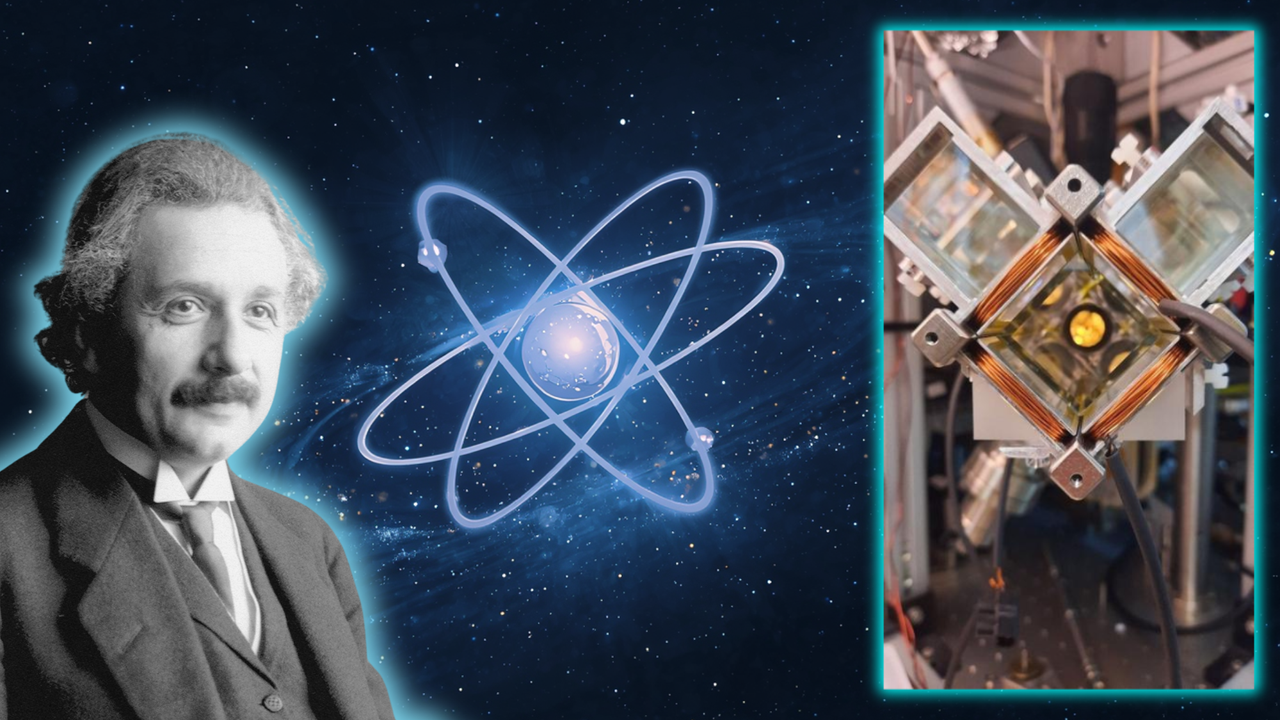
"These two pillars of modern physics have so far eluded all attempts at a unified theoretical framework, but this complex experiment gives more hints as to how such a unification may be achieved."
When you purchase through links on our site, we may earn an affiliate commission. Here’s how it works.
Scientists have spotted the first hints that Albert Einstein's formulation of gravity operates in the quantum realm.
The hints have to do with observations of a falling quantum object, and though this may not seem like a huge deal (literally, we are talking about atoms here), it could be an important step on the road to a theory of ... everything.To start, we have to go back to the early years of the 20th century. Consider Einstein's iconic theory of gravity, general relativity, and the elusive realm of quantum mechanics. While the former describes the universe on scales of planets, stars and black holes, even demonstrating how galaxies and galaxy clusters formed, the latter describes the counterintuitive physics found on scales smaller than atoms. But there is a problem: these two important theories don't play well together.
There is no quantum theory of gravity. However, scientists think we're getting closer to one.
A team of researchers has performed an experiment to find the point where quantum mechanics and general relativity meet. Namely, how the quantum properties of atoms change as those atoms fall under the influence of gravity.
"This is a unique paper, in the sense that it combines a hard experiment with a far-reaching theoretical interpretation, about one of the most fundamental questions in physics: How can gravity, described by Einstein's theory of relativity, and quantum theory, be unified into one understanding of the universe?" team leader Ron Folman of the Ben-Gurion University of the Negev said in a statement. "These two pillars of modern physics have so far eluded all attempts at a unified theoretical framework, but this complex experiment gives more hints as to how such a unification may be achieved."
At the cornerstone of the team's experiment is an important element of general relativity called the equivalence principle.
The equivalence principle states that, for an observer in free fall, gravity should disappear. If that sounds confusing, consider this popular analogy: You are inside a closed elevator with no view of your surroundings. You feel heavy. You might drop a ball, and it would fall to the floor of the elevator. Why would these things happen? Well, there are two options.
You might be sitting stationary on the ground floor, or the elevator could be moving upwards at an acceleration equal to the gravitational field strength of Earth, 9.8 meters per second squared. You can't tell the difference between gravity and acceleration. That's the equivalence principle.Now, let's shake that up. Suddenly, you can't feel weight anymore. You drop the ball, and it floats. Gravity has disappeared, or the upward acceleration has ended. Inside the elevator, two things may have happened, and you can't distinguish between these two either. The elevator cable may have snapped, and you may now be in free fall, or the upward acceleration may have carried you to space and then ceased.