// NATURE NEWS — SPAZIO & SCIENZA
Mobile education builds resilience during shocks in five countries
Nature
(2026) Cite this article
Education systems need to withstand frequent shocks, including disease and climate events, which close schools for more than 222 million children1. During these emergencies, alternative models are needed to deliver education. However, rigorous evaluation of effective educational approaches in these settings is challenging and rare, especially across multiple countries. Here we present results from five randomized trials in India, Kenya, Nepal, the Philippines and Uganda to evaluate the provision of education in emergency settings. We test multiple scalable models of remote targeted tutoring instruction, comparing delivery by governments and non-governmental organizations (NGOs). Whereas text messages have mixed results, tutorials conducted via phone call show effectiveness across diverse settings. We find large and robust effect sizes on learning. These effects are highly cost-effective, and deliver approximately 4 years of high-quality instruction per US$100 spent. Results show large effects when delivered by government teachers or NGO instructors. Together, our results reveal that it is possible to strengthen the resilience of education systems, enabling education provision amid disruptions, and to deliver cost-effective learning gains across contexts and with governments.
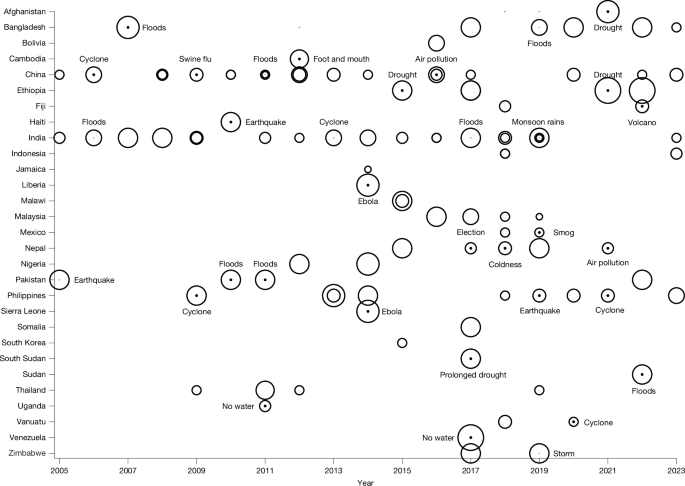
More than 2 billion people live in countries that are affected by emergencies that frequently disrupt education. Although they are frequent and disruptive, education emergencies have historically been understudied. Here we present a new database that documents just how frequent and disruptive such shocks can be. Figure 1 documents the extent of school disruption for a selected set of emergencies over the past two decades.
The graph plots an index of the length of school closures and number of people affected by shocks that have disrupted schooling by country and year. The size of each bubble increases with the duration of school closure, the number of people affected, or both. Thicker or multiple circles represent multiple events in the same year and country. More information on the data compilation is available in the Supplementary Information. The data comprise compiled school closure information based on press releases of the United Nations Office for the Coordination of Humanitarian Affairs (OCHA) ReliefWeb, World Vision, United Nations Children’s Fund (UNICEF), the British Broadcasting Corporation (BBC) and other local outlets. Major disruptions were also identified through The International Disaster Database (EM-DAT).
Schools close for long periods during these emergencies, and learning loss can be substantial2,3,4,5. Education Cannot Wait, the United Nations’ Global Fund for education in emergencies, estimates that 222 million children experience regular schooling disruptions and are in active need of education in emergencies programmes1. In low-income countries, students lose on average 10% of the academic year owing to climate shocks alone6. Moreover, school breaks, although they are not emergencies, are another regular school disruption, and often results in substantial learning loss among low-resource households7,8. These shocks exacerbate a pre-existing learning crisis, leaving many students well behind grade-level expectations9. Fewer than half of primary-age students in low- and middle-income countries are able to read a story or perform two-digit mathematical operations10.
Resilient education systems need to promote learning across settings and to withstand frequent disruptions. Ideally, interventions that promote learning in emergencies should be low-cost, simple to implement and quick to deploy. They should also yield high take-up across different geographies and implementation models and should be targeted to children with diverse educational and cultural backgrounds. Understanding which approaches can be effective across these circumstances requires multi-context, multi-mo