// NATURE NEWS — SPAZIO & SCIENZA
Identification of broadly tumour-reactive γδ TCRs from multiple myeloma
Nature
(2026) Cite this article
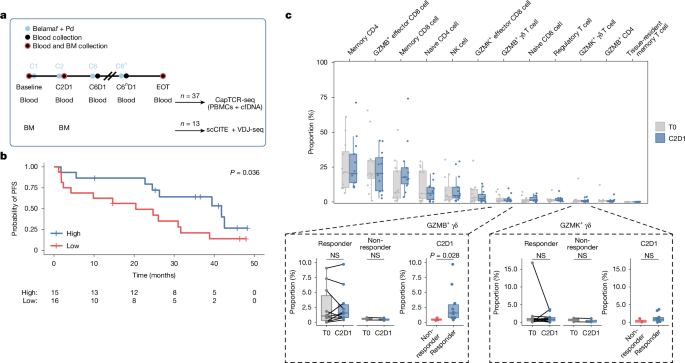
γδ T cells are becoming increasingly appreciated for their antitumour capacity and role in mediating responses to immune checkpoint blockade1,2,3. Unlike classical αβ T cells, the degree to which γδ T cells rely on their T cell receptors (TCRs) to induce antitumour responses remains unclear. The challenge of distinguishing γδ T cells with tumour-reactive TCRs from bystander γδ T cells limits our understanding of tumour-reactive γδ T cell biology and the translation of their TCRs into immunotherapeutics. Here we present PreGame, a machine-learning algorithm capable of identifying tumour-reactive γδ T cells from single-cell CITE sequencing data. We use PreGame to identify tumour-reactive γδ T cells from patients with multiple myeloma or other solid cancers, and confirm the specificity of their TCRs to tumour cells. Clinically, we demonstrate that expansion of tumour-reactive γδ T cells is an early biomarker of response in patients with multiple myeloma receiving combination therapy with belantamab mafodotin. We also identify a γδ TCR epitope in the ubiquitously expressed HLA-C protein and a logic gate that enables tumour immunosurveillance. Thus, PreGame is a versatile tool that can accelerate our understanding of γδ T cell biology and facilitate the translation of γδ TCRs into universal therapeutics.
T cells are crucial for immunosurveillance against multiple myeloma (MM) and other tumours4,5,6. Although cytotoxic CD8+ αβ T cells are often the focus, T cells that express γδ TCRs are becoming increasingly recognized for their crucial function in response to cancer therapies, including immune checkpoint blockade (ICB)1,2,3,6,7,8,9,10,11,12. However, γδ T cells have both innate-like and adaptive-like immune functions. Indeed, it remains unclear whether tumour-infiltrating γδ T cells directly recognize tumour cells via their TCRs (that is, adaptive-like)1,13,14,15,16 or function in a TCR-independent manner by relying on receptors such as NKG2D or NKp30 (also known as NCR3) to recognize stress ligands on cancer cells (that is, innate-like)2,7,10,17,18. Without a high-throughput method of distinguishing tumour-reactive γδ T cells—that is, those with tumour-reactive TCRs (henceforth, TR γδ T cells)—from bystander γδ T cells in the same tumour microenvironment (TME), these uncertainties will remain. Pertinently, most known γδ TCR ligands are independent of the major histocompatibility complex (MHC)19, which is in contrast to the constitutive MHC dependency of αβ TCRs. Therefore, TR γδ TCRs have the potential for translation into universal cancer therapeutics without the requirement for HLA matching in patients11.
The antitumour activity of αβ T cells is often leveraged by immunotherapeutics to treat MM, including via CAR-T cells, but patients often relapse with resistant disease. Next-line immunotherapies are continually being explored, including the administration of antibody–drug conjugates (ADCs) that target surface proteins found on MM cells. The ADC belantamab mafodotin (referred to as belamaf hereafter), which binds to the B cell maturation antigen (BCMA), has shown high efficacy in combination therapies and is approved to treat MM in multiple jurisdictions20,21,22. Belamaf exerts its antitumour activity via direct cytotoxicity, antibody-dependent cellular cytotoxicity and phagocytosis, and immunogenic cell death23. Immunogenic cell death leads to the release of antigens and disruption of the TME in a manner that can augment the antitumour T cell response24. Across DREAMM studies20,22,25,26, belamaf has consistently demonstrated durability of responses in patients with MM despite long dosing intervals to manage toxicities. This result suggests that there is an unknown contribution by the adaptive immune system to outcomes.
Here we describe our development of PreGame, a machine-learning (ML) algorithm capable of identifying TR γδ T cells from single-cell CITE sequenc