// NATURE NEWS — SPAZIO & SCIENZA
China punishes prominent academics exposed by research sleuth
Search author on:
PubMed
Google Scholar
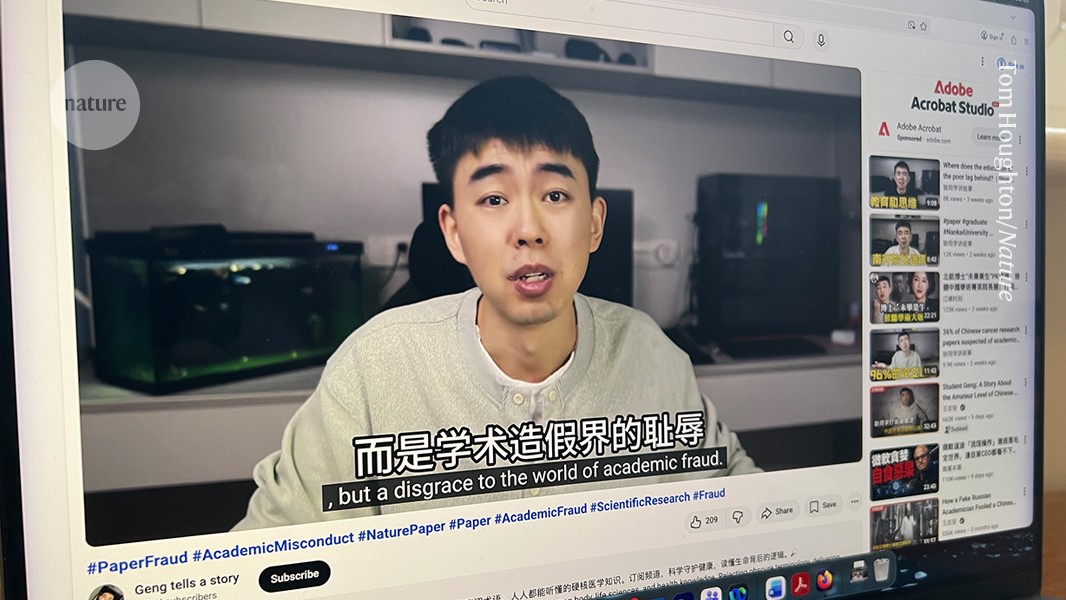
A social-media sleuth known as Student Geng has released a series of videos highlighting cases of alleged research misconduct.Credit: Tom Houghton/Nature
China’s national funding agency has reprimanded and penalized four senior academics and their colleagues after a sleuth flagged data anomalies in their published papers.
The National Natural Science Foundation of China (NSFC) found violations ranging from data fabrication to data tampering in four papers, according to an announcement from the agency on 28 August.
The academics and their colleagues were banned from applying for funding from the NSFC, either as individuals or members of teams, for between three and seven years. The agency also cancelled funded research projects related to three of the four papers and recovered the money that it had already distributed to them.
Geng Hongwei, the sleuth and video blogger who called out the papers, known online as Student Geng, says that the severity of the punishments is in line with his expectations. He also says that he feels “a little proud” that his efforts, highlighted in a series of viral videos, have led to an official response.
‘Student Geng’ ignites research-integrity scandal in China after calling out senior academics
The penalties were part of a wider crackdown on research misconduct by the NSFC, with 31 research groups and institutes identified in the agency’s statement. Some of the other offences addressed include buying and selling data, plagiarism and misuse of research funds.
Although the NSFC’s statement does not provide the titles of the papers in question, Nature journalists have verified that all four of them were published in Nature or Nature-branded journals. Two were retracted on 29 July and the others now contain editor’s notes acknowledging concerns about their data. Geng said that a key reason that all of the papers he raised concerns about were published in Nature-branded journals is that these journals require researchers to publish their raw data, making his investigations possible.
Nature’s careers and news teams are independent of the journal’s research section and its publisher, Springer Nature. When contacted for comment, Erika Pastrana, vice-president of the Nature research and reviews journals, said that “all papers flagged to us will be investigated”. The journals “will provide updates on papers with editor’s notes once investigations are complete”.