// NATURE NEWS — SPAZIO & SCIENZA
This super-cold microscope could spur a quantum revolution
Search author on:
PubMed
Google Scholar
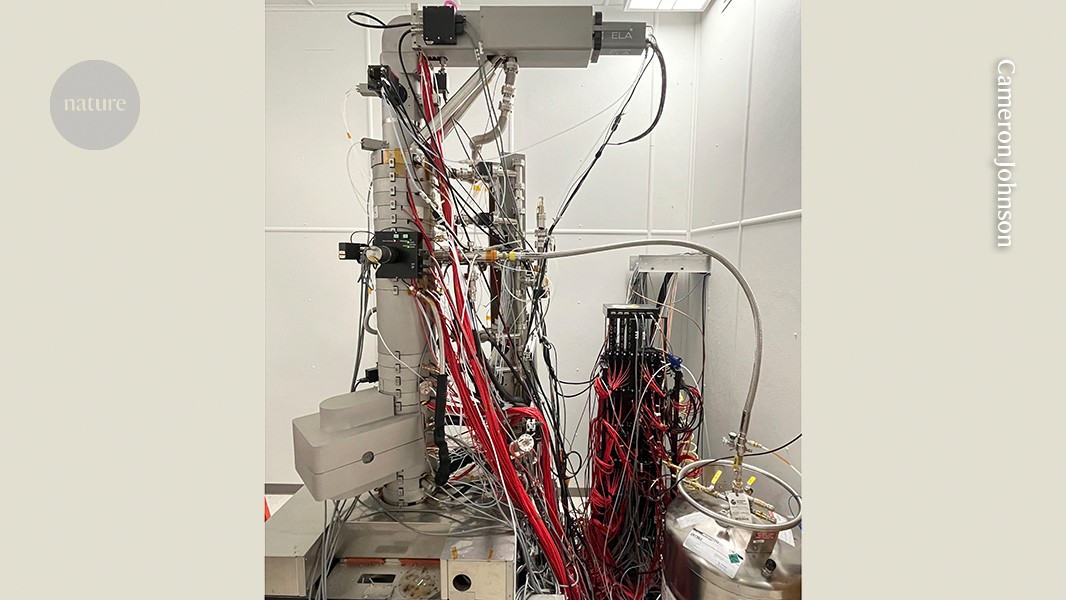
GAIA is a scanning transmission electron microscope with a built-in system to cool samples to ultra-low temperatures with liquid helium. Credit: Cameron Johnson
When it comes to imaging materials, the colder the sample is, the better. At room temperature, atoms hum with thermal energy and appear blurry in images, but at ultra-cold temperatures, near absolute zero (0 kelvin), they come almost to a standstill and can even adopt strange quantum behaviours. So, scientists have been on a decades-long quest to adapt some of their most powerful imaging instruments — transmission electron microscopes (TEMs) — to work at the coldest temperatures possible.
The world’s strongest MRI machines are pushing human imaging to new limits
Now, their dreams are finally becoming reality. Last year, researchers in the United States reported1 using an attachment for TEMs that cools samples to as low as −253 °C (20 kelvin) with liquid helium, enabling stable imaging of samples at atomic resolution for more than ten hours.
And by early next year, instrument maker Bruker, based in Billerica, Massachusetts, will ship the first-ever scanning transmission electron microscope (STEM) that stably operates near absolute zero using liquid helium to three laboratories in Canada, Germany and the United States. The device — dubbed GAIA, for Generational Advance in Instrumentation for Analysis — can image materials at temperatures as low as about −266 °C (7 kelvin) for 30 hours or more.
“It’s a little bit non-humble to name your microscopes after gods, but we’re pretty confident” in its abilities, says Tracy Lovejoy, vice-president and general manager at a division of Bruker. (In ancient Greece, Gaia was the goddess of Earth.)
Researchers are thrilled about the advancements and think that GAIA, in particular, will open avenues for exploring never-before-seen properties of materials.
Making samples one billion times bigger lets simple microscopes pinpoint amino acids
“It’s ridiculously exciting,” says Shelly Conroy, an electron microscopist at Imperial College London. Conroy has secured a time slot to use the GAIA microscope that will be delivered to the Ernst Ruska-Centre for Microscopy and Spectroscopy with Electrons in Jülich, Germany. The two other instruments will go to Oak Ridge National Laboratory in Tennessee and the Canadian Centre for Electron Microscopy in Hamilton.