// NATURE NEWS — SPAZIO & SCIENZA
Gravitational torque drives multidecadal variations in length of day
Nature
(2026) Cite this article
Fluctuations in the length of day (LOD) on decadal timescales are caused primarily by an exchange of angular momentum between the Earth’s mantle and core1,2,3. Several mechanisms have been proposed to explain this exchange, including electromagnetic4,5,6,7 and topographic8,9,10 coupling at the core–mantle boundary (CMB) and a gravitational torque by the inner core11,12. However, the precise nature of the core–mantle torque remains unknown. Here we show that the seismically reconstructed differential rotation of the inner core13,14,15 and core flows derived from magnetic field changes16,17 suggest that the multidecadal LOD changes are driven primarily by the gravitational torque and resisted by electromagnetic and topographic torques, consistent with results from Earth-like dynamo models18. Our reconstructed torque histories, although tied to the accuracy of the inner core rotation and core flow models, support a lowermost mantle that features near-neutrally buoyant thermochemical piles19,20,21, a post-perovskite (pPv) phase with a low viscosity22 and a highly conducting23,24 iron-enriched layer a few kilometres thick at its base25. Our results also suggest a low-viscosity inner core deforming in only a few years26,27,28 and yield an upper limit on the stratification at the top of the fluid core. Altogether, our study contributes to bringing into focus an emerging picture of the deepest regions of our planet.
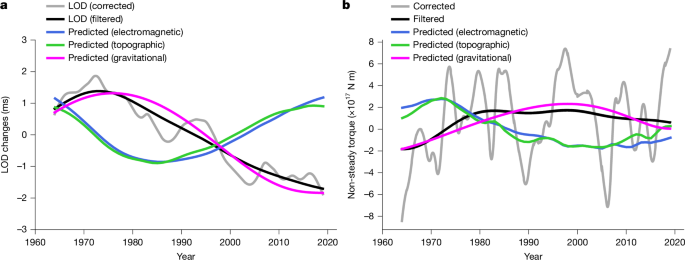
The rate of Earth’s rotation is not constant and this causes changes in the LOD29. LOD changes (denoted by ΔLOD) occur over a broad range of timescales, from daily variations caused by tidal effects30, to seasonal and annual changes caused mainly by atmospheric winds31 and to a gradual increase over millions of years caused by lunar tidal friction32. Fluctuations of several milliseconds (ms) also occur on timescales of 10–70 years, as shown in Fig. 1a between 1964 and 2019.
a, Observed decadal ΔLOD (in ms) between 1964 and 2019 (grey line) after removing the seasonal contributions from the atmosphere and oceans and the secular trends from lunar tidal friction, glacial isostatic adjustment and barystatic processes (Methods). The black line shows the multidecadal ΔLOD, obtained by applying a third-order low-pass Butterworth filter with a cut-off period of 30 years. b, The equivalent torque on the mantle (in N m) required to explain the decadal (grey line) and multidecadal (black line) ΔLOD. The blue, green and magenta lines are the predicted electromagnetic, topographic and gravitational torques, respectively (in b) and resulting multidecadal ΔLOD (in a) based on the ensemble solution of the core flow model from ref. 17 and inner core rotation time history from ref. 13, and with Kem = 1.0, Ktop = 0.4, Γ = 1.3 × 10¹⁹ N m and τ = 6 years.
These decadal ΔLOD are the focus of our study. They are caused primarily by an exchange of angular momentum between the core and mantle. Flows near the top of the fluid core can be reconstructed from the observed secular variation of the geomagnetic field16. Predictions of the ΔLOD based on the angular momentum carried by these flows match the observed changes well1,2,3, confirming their core origin.
However, the nature of the torque between the core and mantle responsible for these changes remains unclear. Core flows only exert a weak viscous stress on the CMB, too small to explain the required torque. Core flows also exert an electromagnetic stress on the electrically conducting mantle4,5 and if a thin (several kilometres thick) layer of iron-enriched material is present at the base of the mantle with a conductance of G ≈ 108 S, as suggested by studies of Earth’s nutations33,34, electromagnetic coupling can produce a torque of the required magnitude6,7. Predictions of the electromagnetic torque have been presented in several studies5,9,35 and, although some correlations are observed, the match with the observed decadal ΔLOD i